SMARTAO AnalogPilot | AI-powered. Engineer-driven.

RF/analog IP and system automation built for engineering closure.

AnalogPilot turns reusable testbenches, Cadence-oriented simulation, metric extraction, optimization, behavioral/RNM modeling, system-level verification, and report generation into one practical engineering loop.

SpecTargets, constraints, corners, design variables, and architecture candidates.
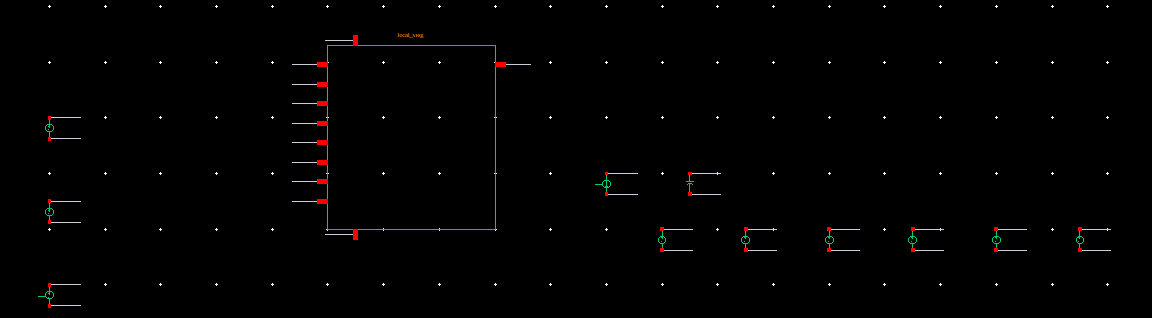
TestbenchReusable DUT wrappers, stimuli, terminations, node maps, and SKILL schematic hooks.
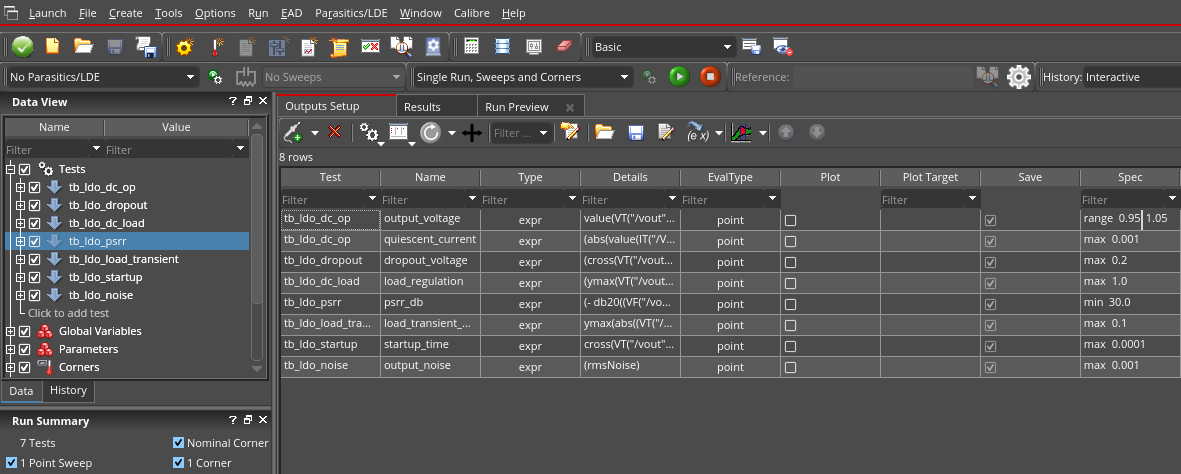
SimulationSpectre, AMS, PSS/HB/PNoise, transient, PVT, Monte Carlo, and post-processing.
OptimizeMetric-driven search, architecture comparison, model calibration, and write-back.
Reportmetrics.txt, visual figures, datasheets, closure summaries, and reusable models.
Platform

A testbench platform, system verification platform, optimization platform, and modeling platform in one environment.

AnalogPilot is organized around reusable RF/analog module classes, end-to-end system scenarios, and customer-owned design instances. Developer-provided platform files and customer-generated workspaces are separated so upgrades do not overwrite private projects.

208Formal RF/analog modules
208Modules with tb_main testbenches
1384L3 optimization-ready metrics
66Coarse/fine mapping samples
01

Testbench Automation

Module- and system-aware testbench packages include DUT wrapper contracts, variableized parameters, stimuli, node maps, OCEAN/MDL measurement hooks, and SKILL schematic-generation entry points.

02

Metric-Driven Optimization

Optimization reads normalized metrics.txt outputs, compares candidates, handles PVT/MC validation, and can write optimized variables back into Cadence-oriented collateral.

03

Modeling and Calibration

Behavioral, RNM/EEnet, and coarse/fine model flows support faster exploration, schematic equivalence checks, and reusable model calibration.

04

System-Level Verification

Registered preprocessors and postprocessors cover supply ripple, jittered clocks, PAM4, OFDM/modulation, fading/channel stress, ADC FFT, PLL phase noise, spurs, RF metrics, SerDes DSP, and system closure views.

05

PDK-Aware Deployment

A design intent can own multiple PDK-specific implementations. Each implementation is optimized and validated under its own PDK profile rather than pretending one schematic is portable.

06

Private Expansion

Customers can add private design instances, architectures, and data locally. SMARTAO platform upgrades remain separate from customer-internal IP knowledge.

Coverage

Coverage from leaf circuits to end-to-end system scenarios.

AnalogPilot is not just an IP module list. It provides repeatable flows for RF/mmWave, power management, data conversion, high-speed IO, clocking, passive/EM, sensors, automotive, wireless, radar, SATCOM, Bluetooth-style, memory-PHY, optical-link, and datacenter power-delivery system scenarios.

RF/mmWave
LNAPAMixerPLL/VCO/DCOLO DistributionPhased ArrayRF Front-End
Power
LDOBuck/BoostBattery ChargerPower IntegrityPOR/UVLOPMIC
Data / IO
SAR/DSM/TI ADCPipelined ADCDACSerDesCDRPRBSPAM4/PAM6/PAM8448G
Clocking
PLLADPLLDCOFOD/DividerDTC/TDCJitterClock TreeReference Conditioner
Passive / EM
InductorTransformerBalunTLineCouplerFilterPackage/Board
Systems
FMCW RadarWiFi/CellularSATCOMBluetoothAutomotiveSensor Readout

Class / Architecture / Instance Separation

Reusable module classes, candidate architectures, and project-specific design instances are stored separately. A 1 V LDO, a 2 V LDO, and several LNA or SerDes front-end architectures can be optimized independently or compared in one candidate run without overwriting each other.

Proof / Demos

Representative IP and system output figures generated by the platform.

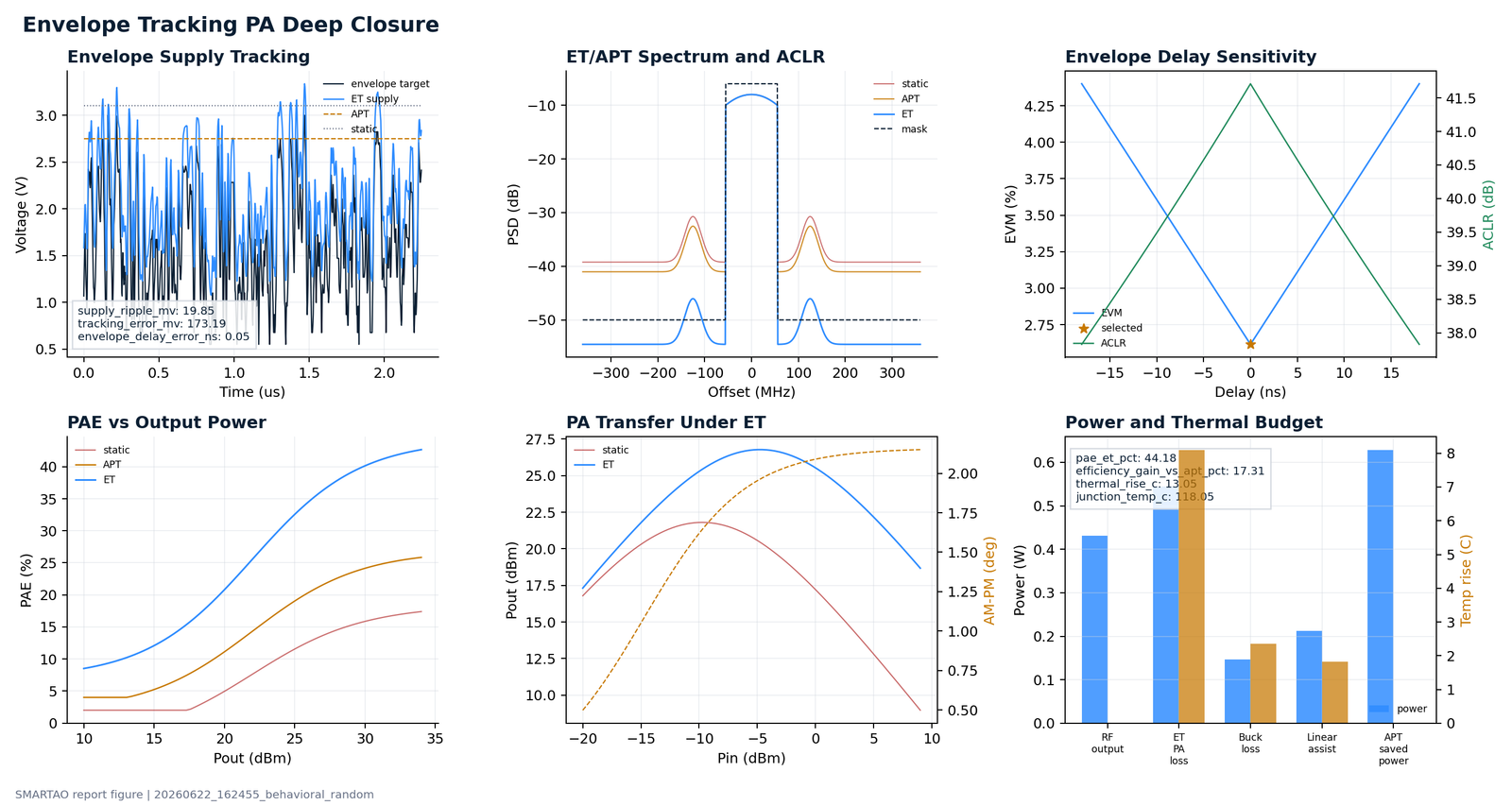
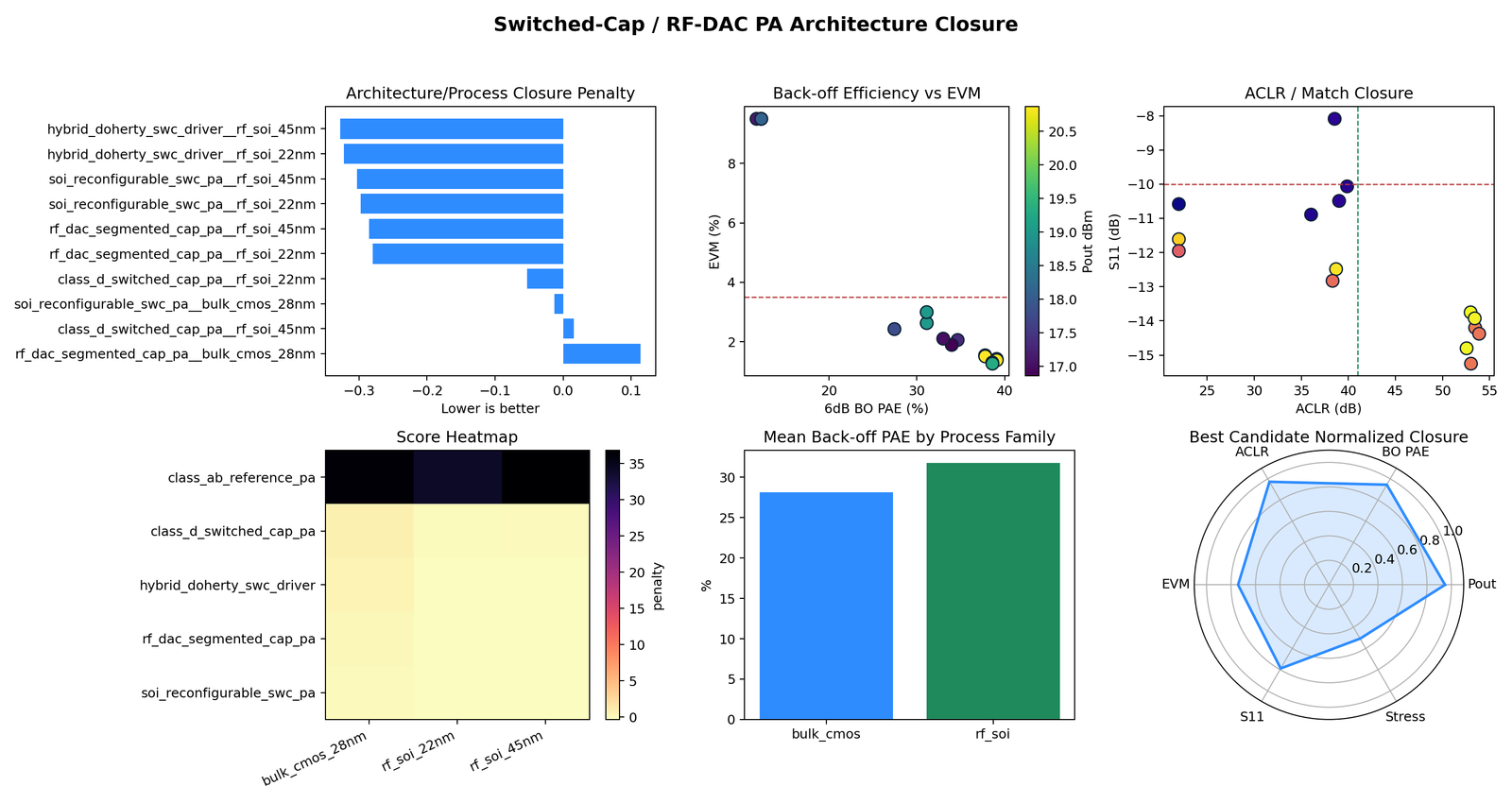
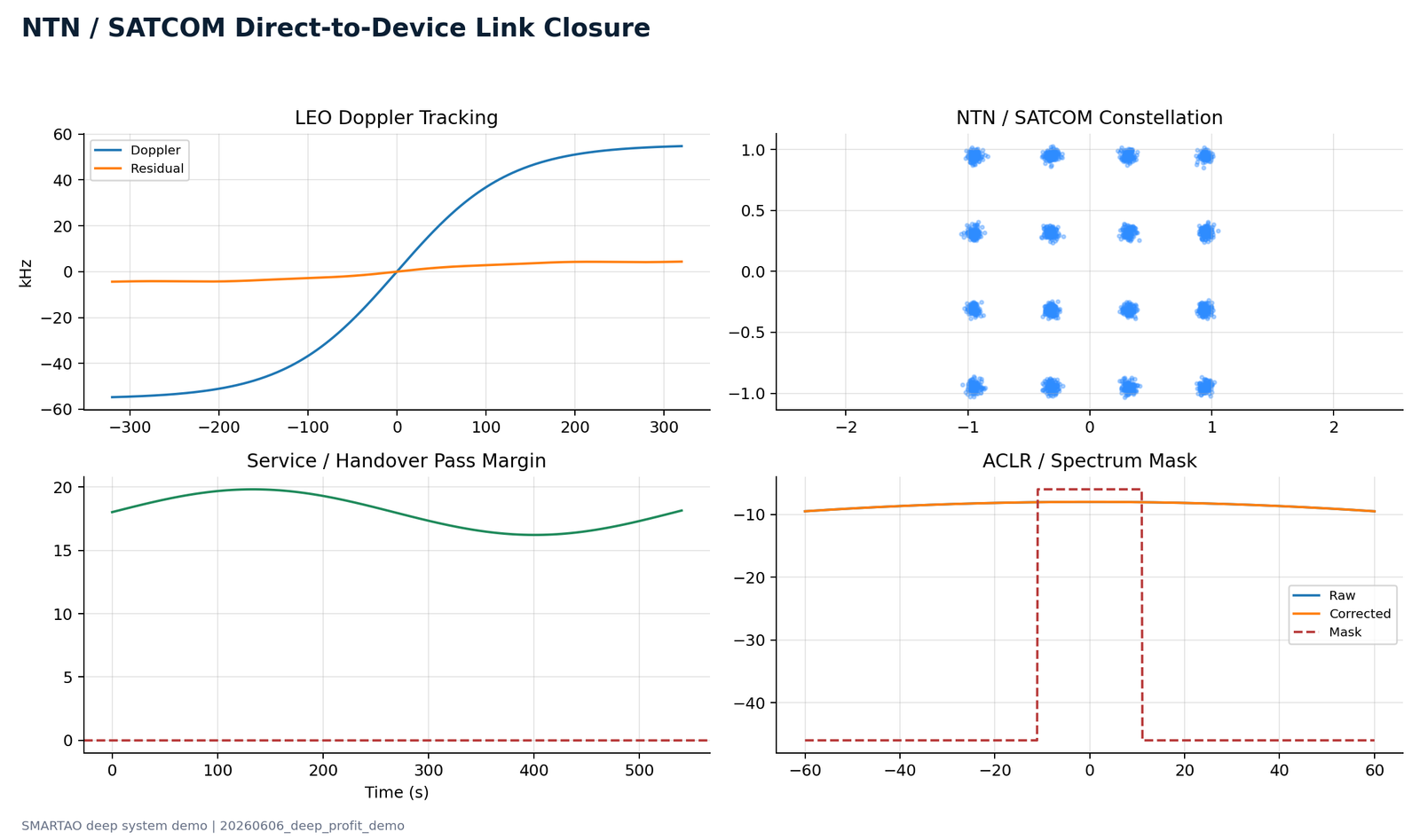
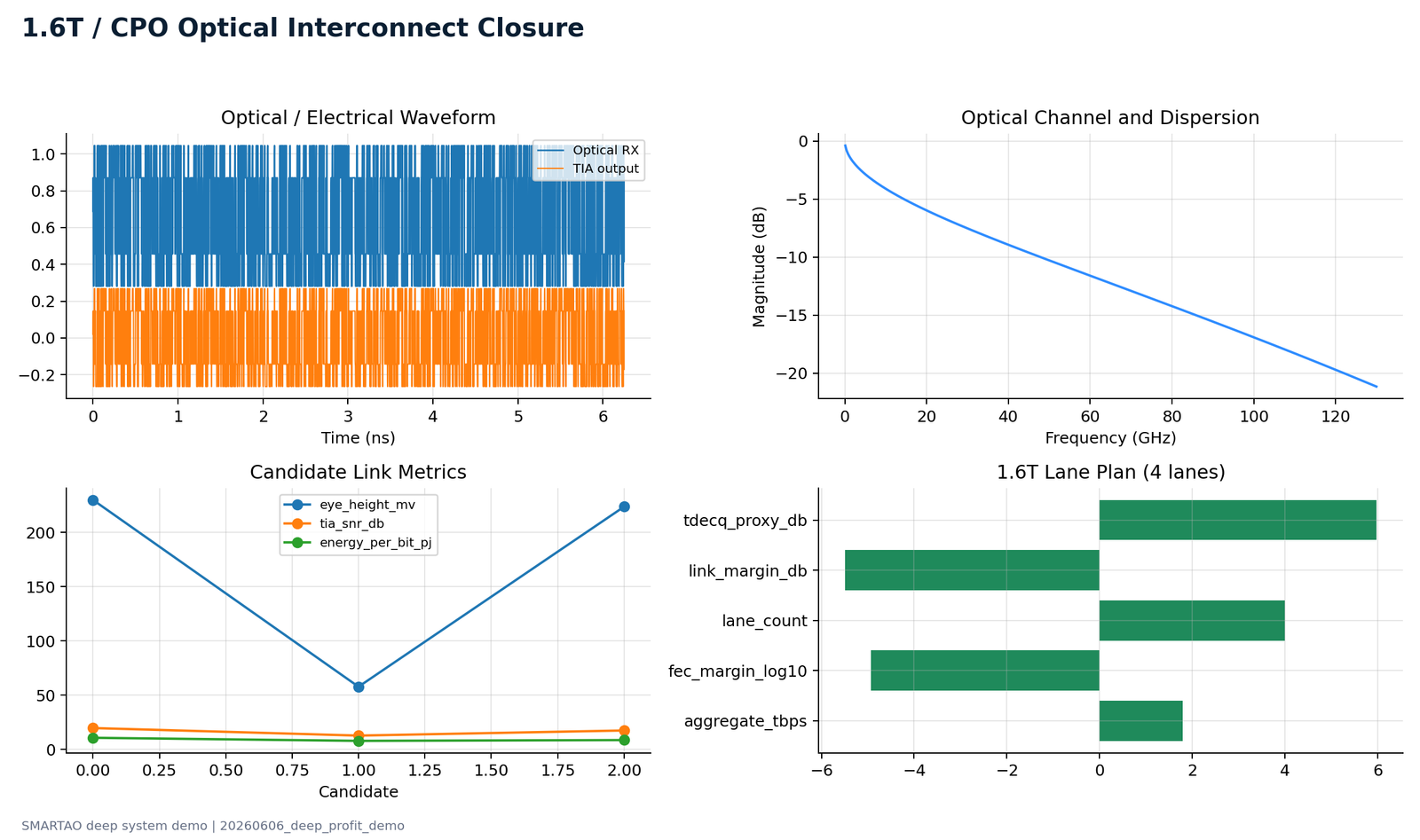
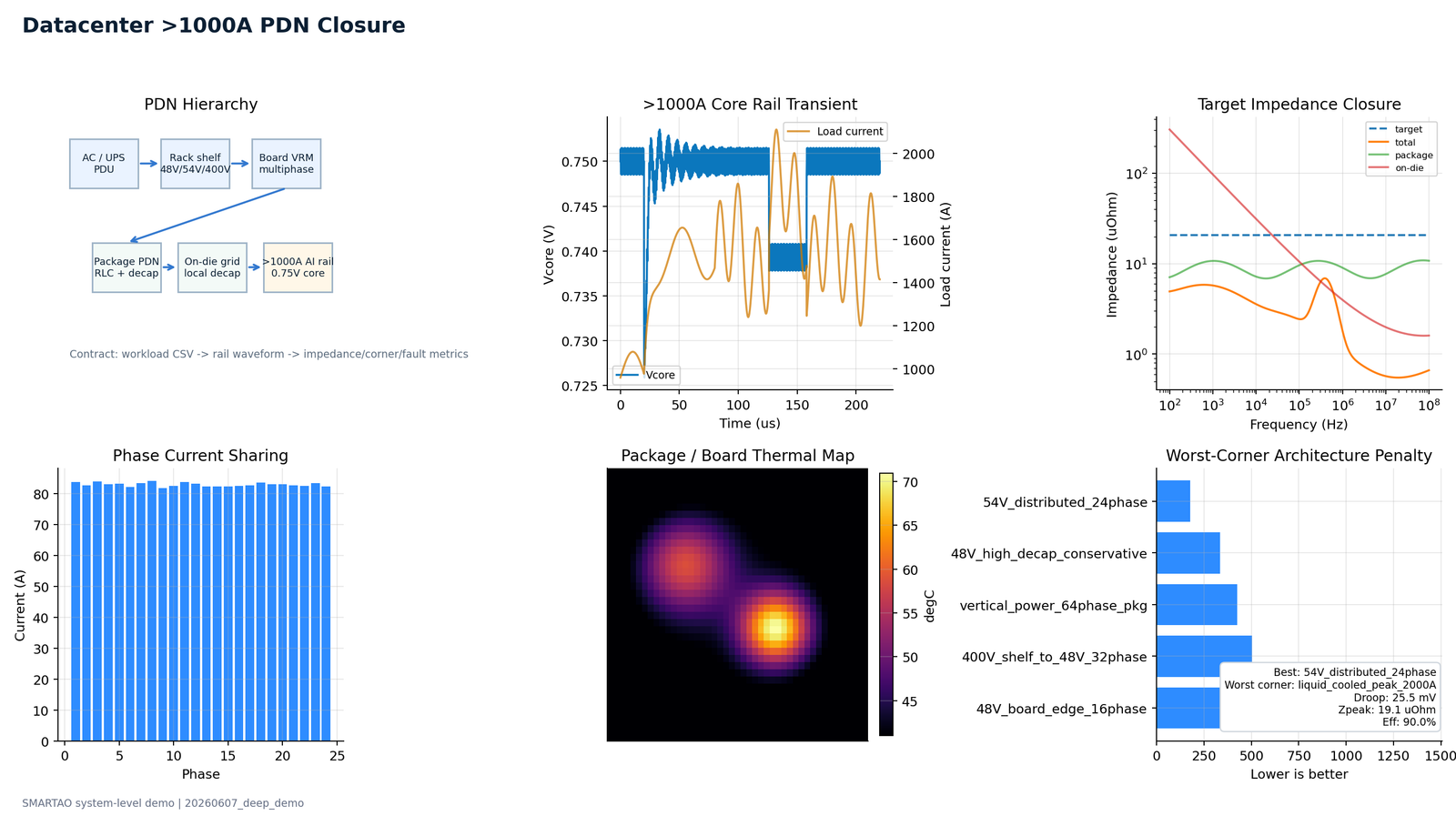
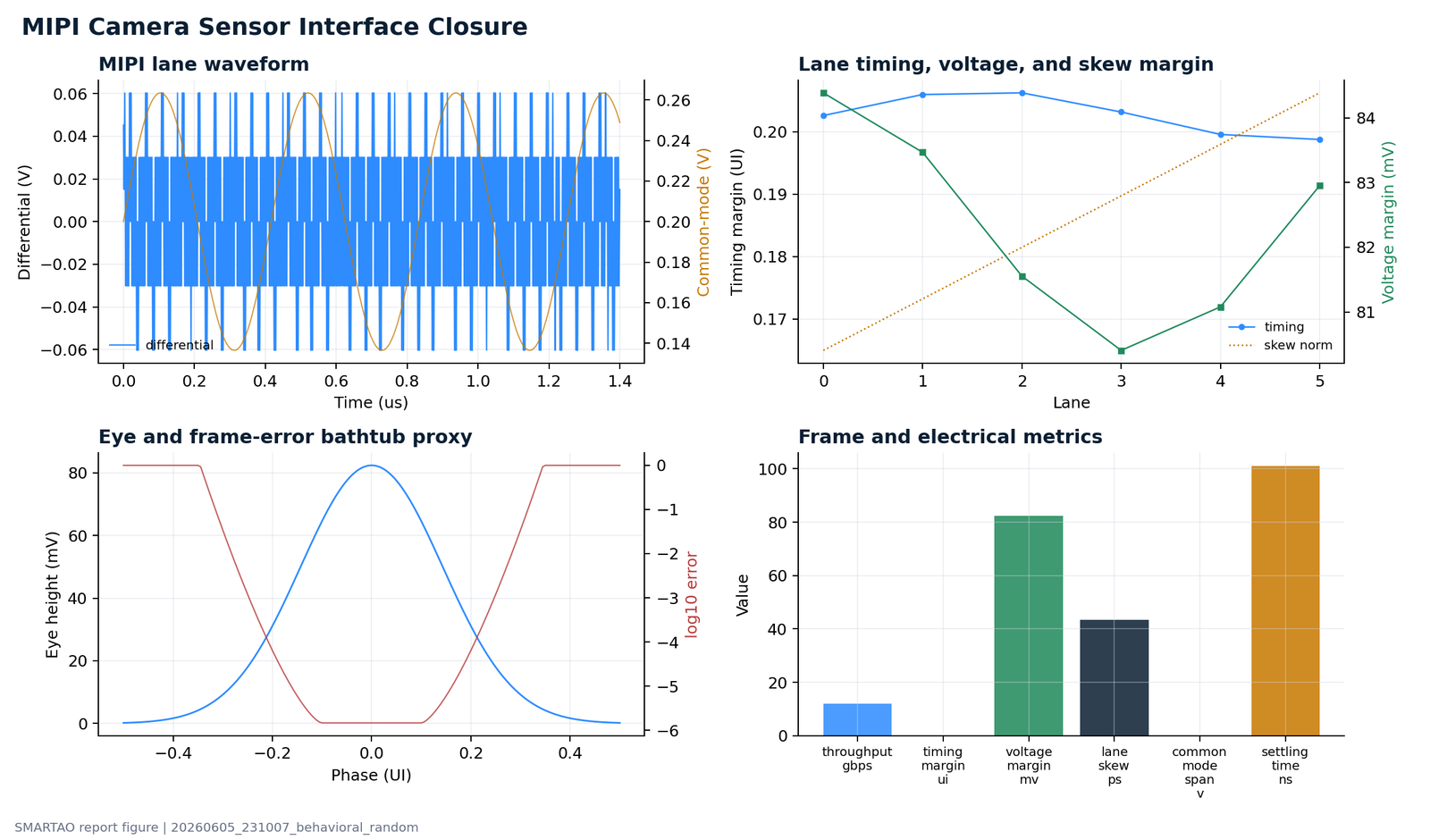
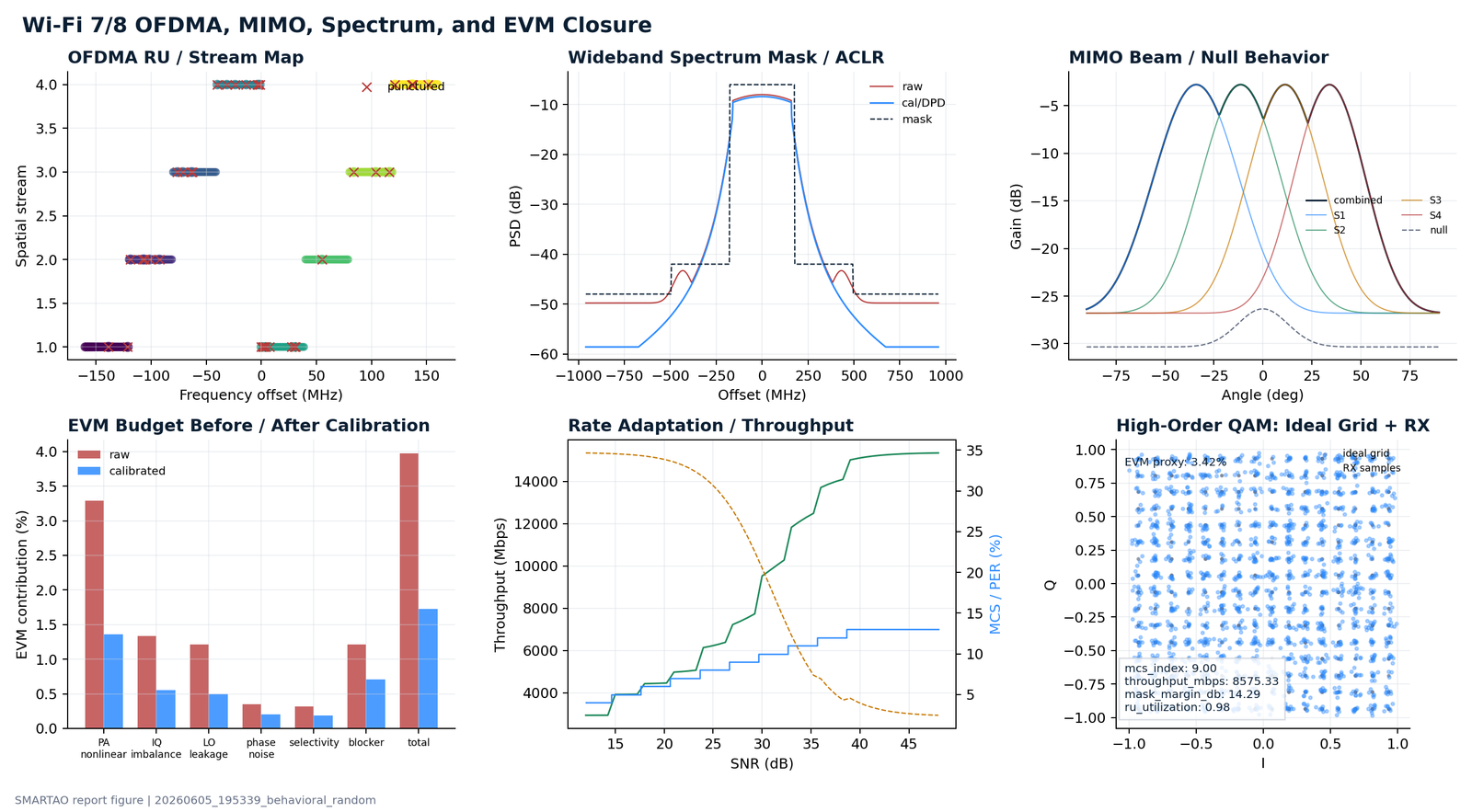
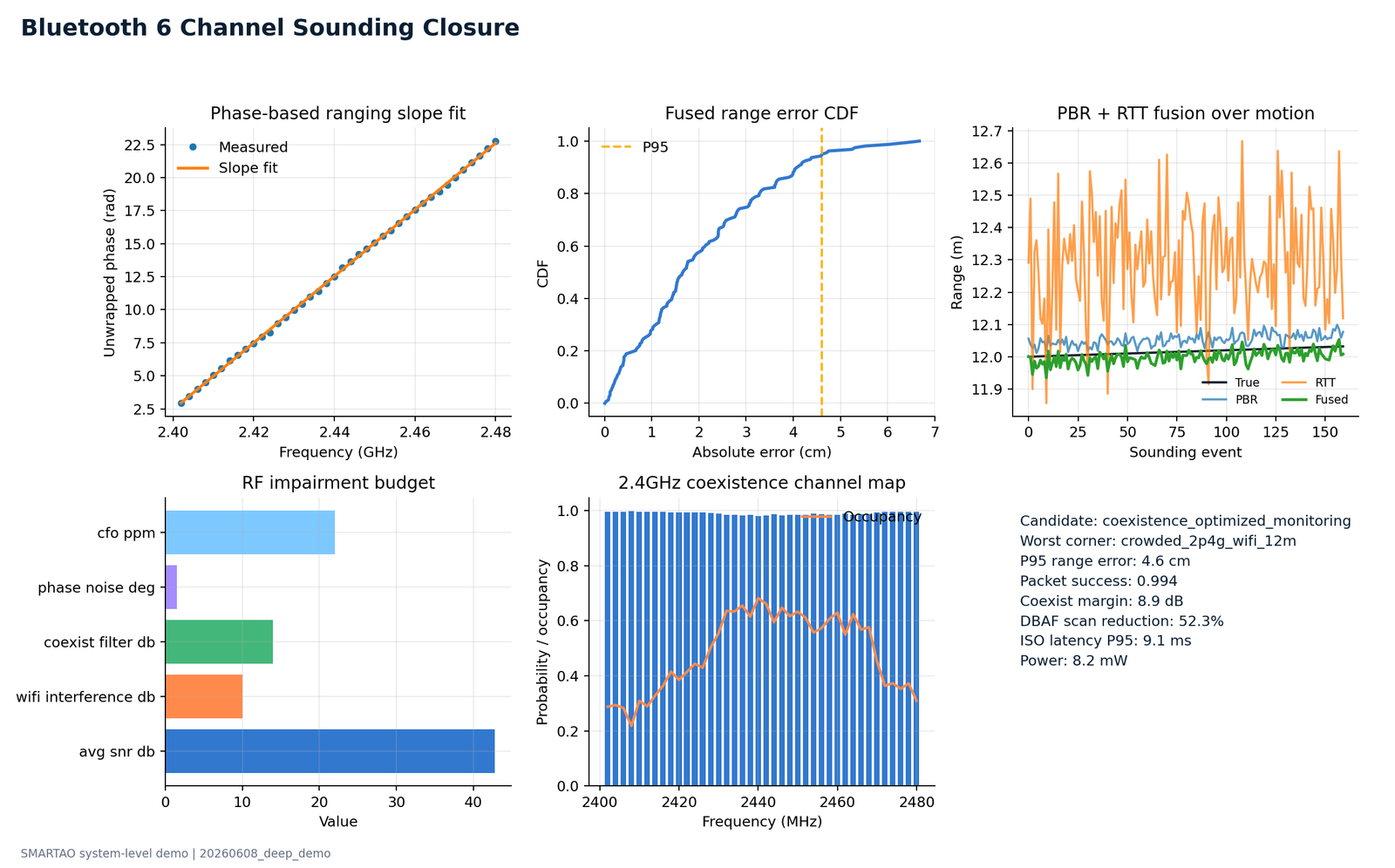
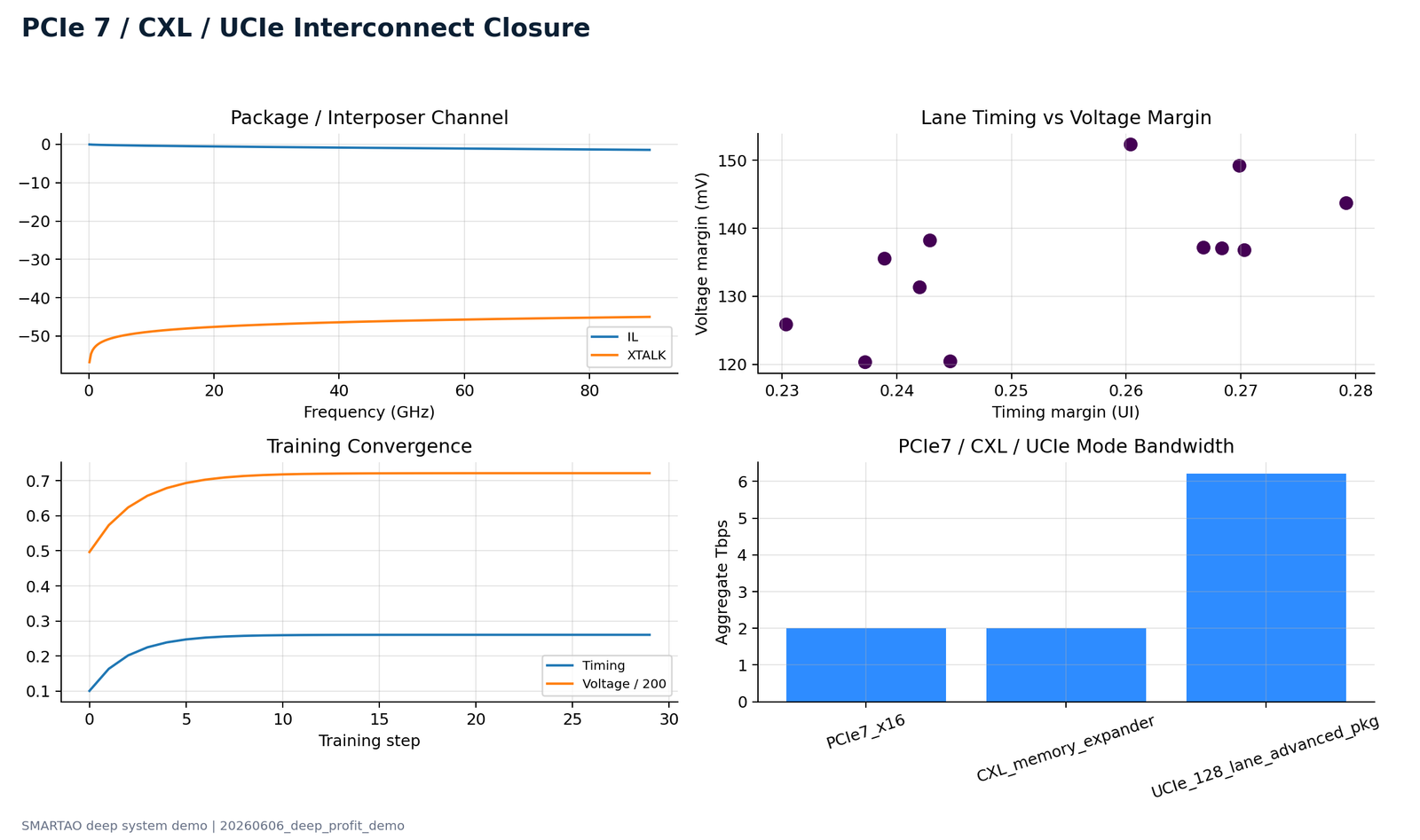
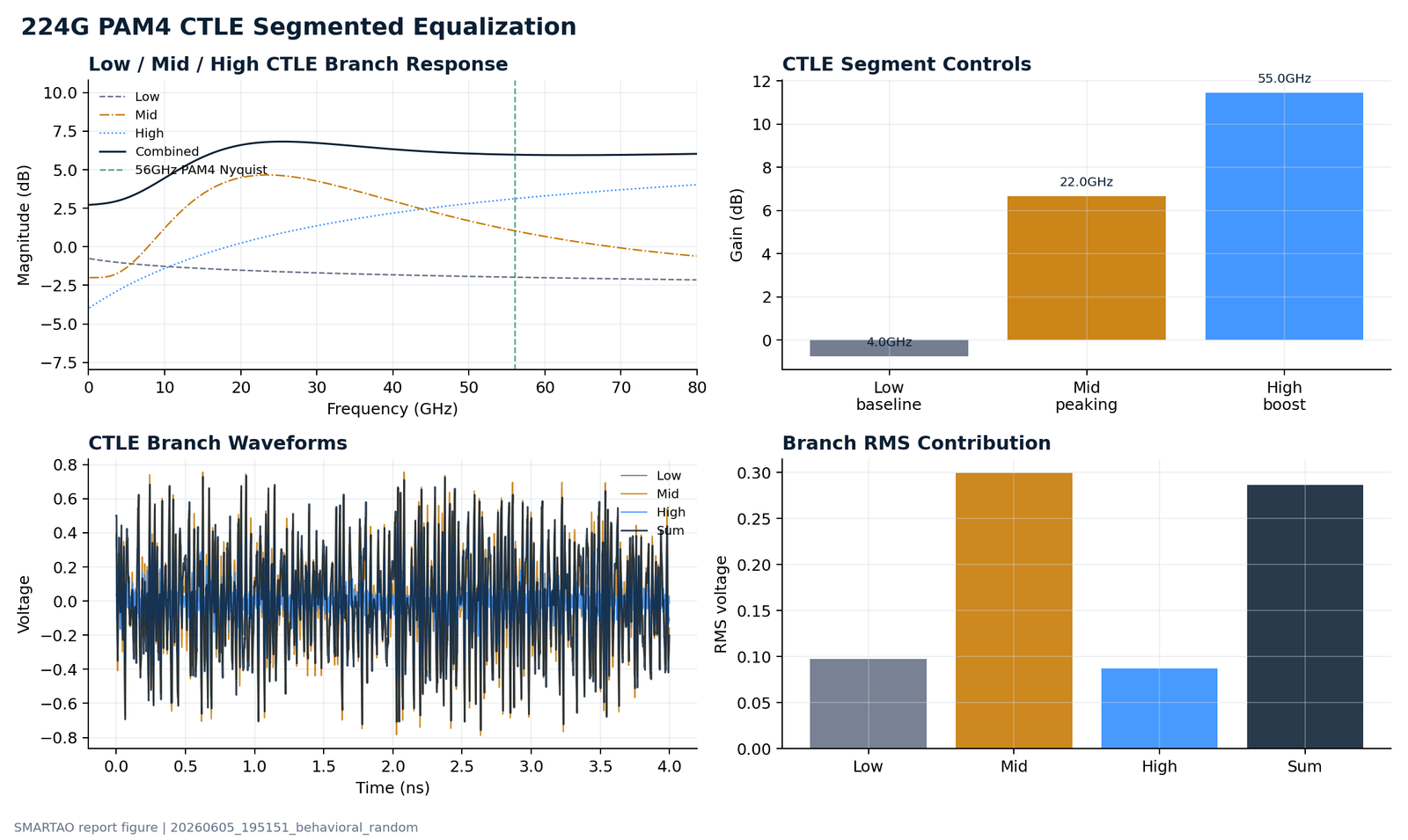
Normal runs can produce report-ready figures, not only scalar metrics. The examples below are drawn from current AnalogPilot demos and show closed-loop coverage across data-converter calibration, RNM/EEnet model validation, passive RLCK fitting, PLL noise, FOD/fractional-divider spur cancellation, high-speed SerDes up to exploratory 448G/lane links, PCIe 7 / CXL / UCIe chiplet links, GDDR7 and HBM4 memory PHYs, 1.6T/CPO-style optical links, datacenter high-current power delivery for AI workloads, WiFi7/5G RF front ends, Bluetooth 6 channel sounding, RF transceivers, FMCW and 4D imaging radar, mmWave arrays, and NTN/SATCOM systems.

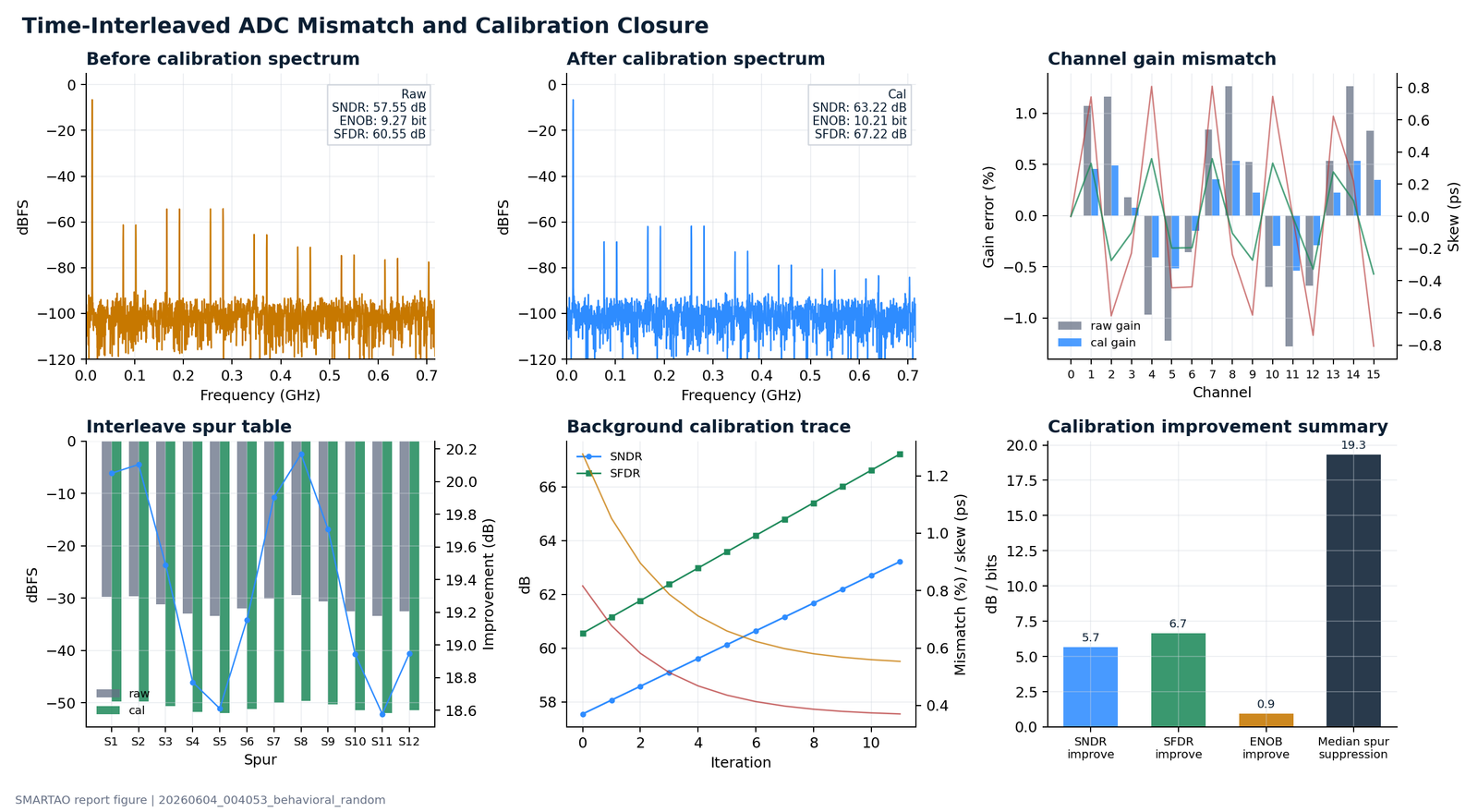
TI ADC mismatch calibration

TI ADC mismatch calibration

Raw versus calibrated spectrum, channel mismatch, interleave spur suppression, and background calibration trace.

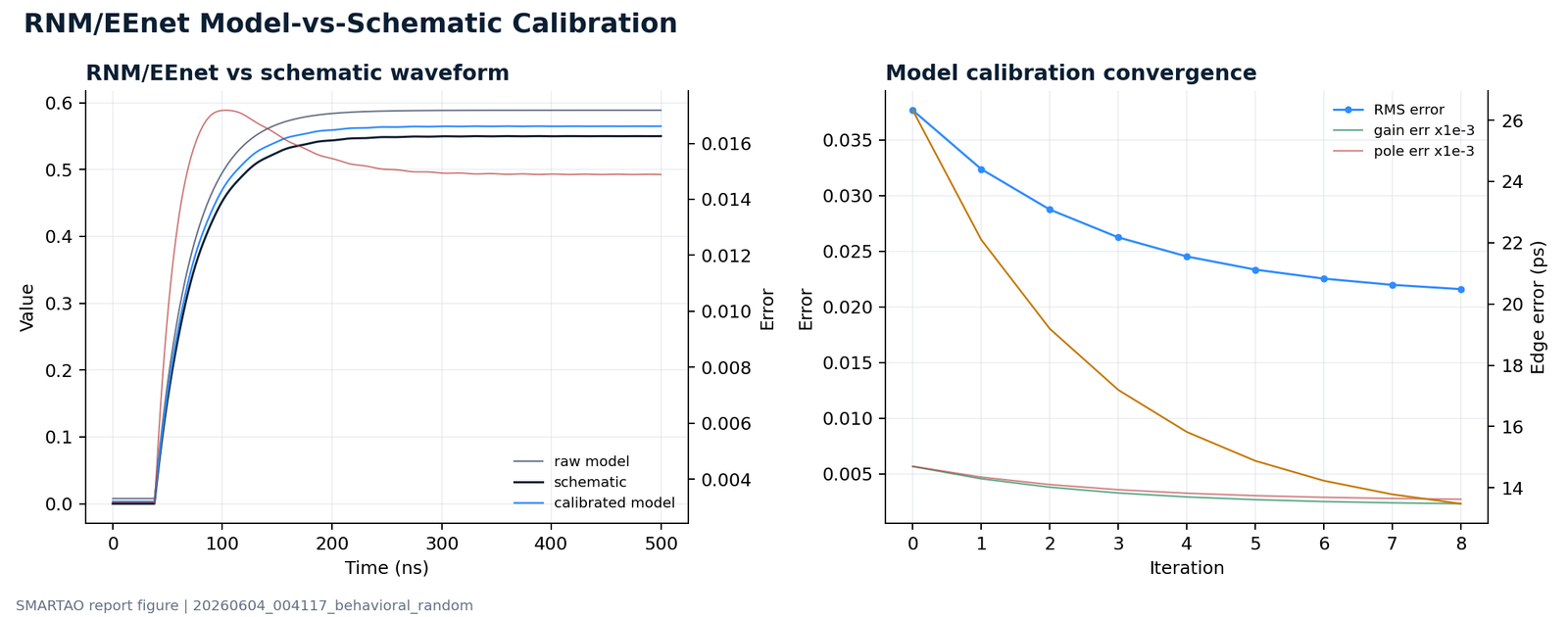
RNM/EEnet model validation

RNM/EEnet model validation

Raw model, calibrated model, schematic waveform, residual error, and calibration convergence in one view.

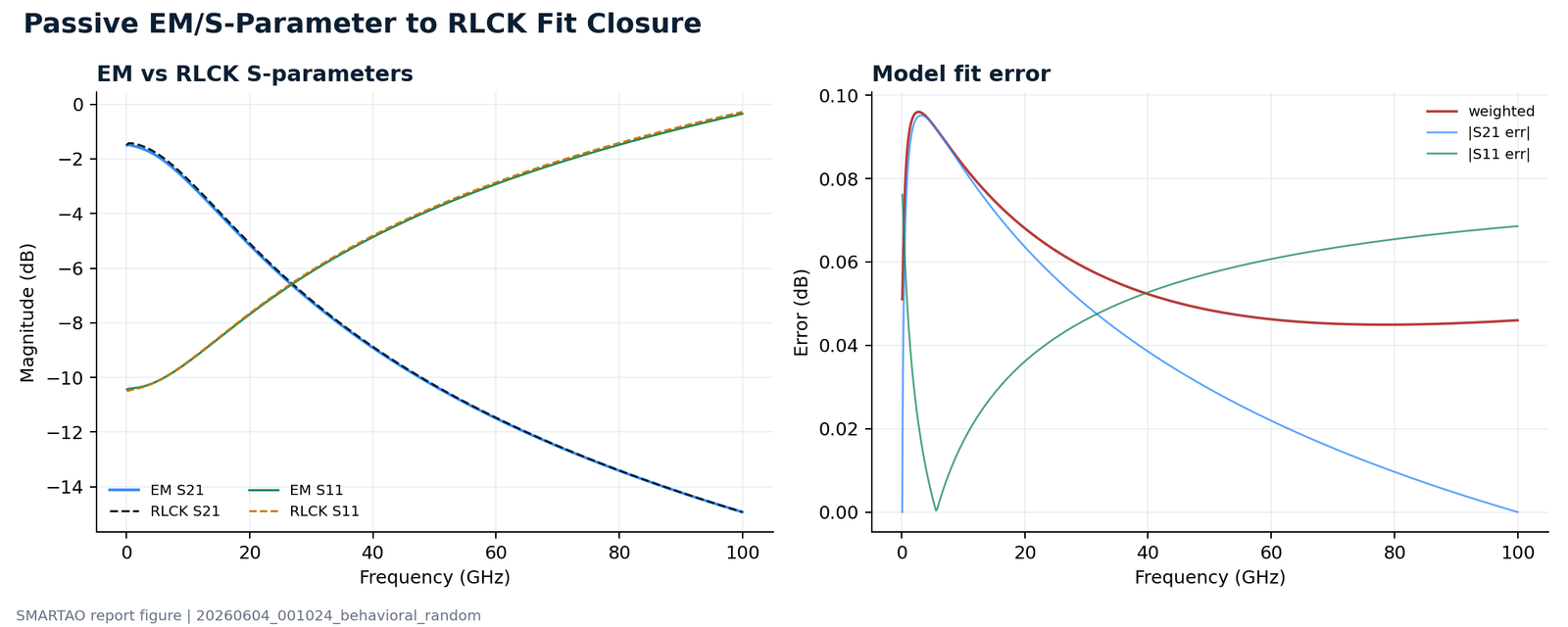
Passive EM-to-RLCK closure

Passive EM-to-RLCK closure

EM-like S-parameters overlaid with fitted RLCK model curves and frequency-dependent fitting error.

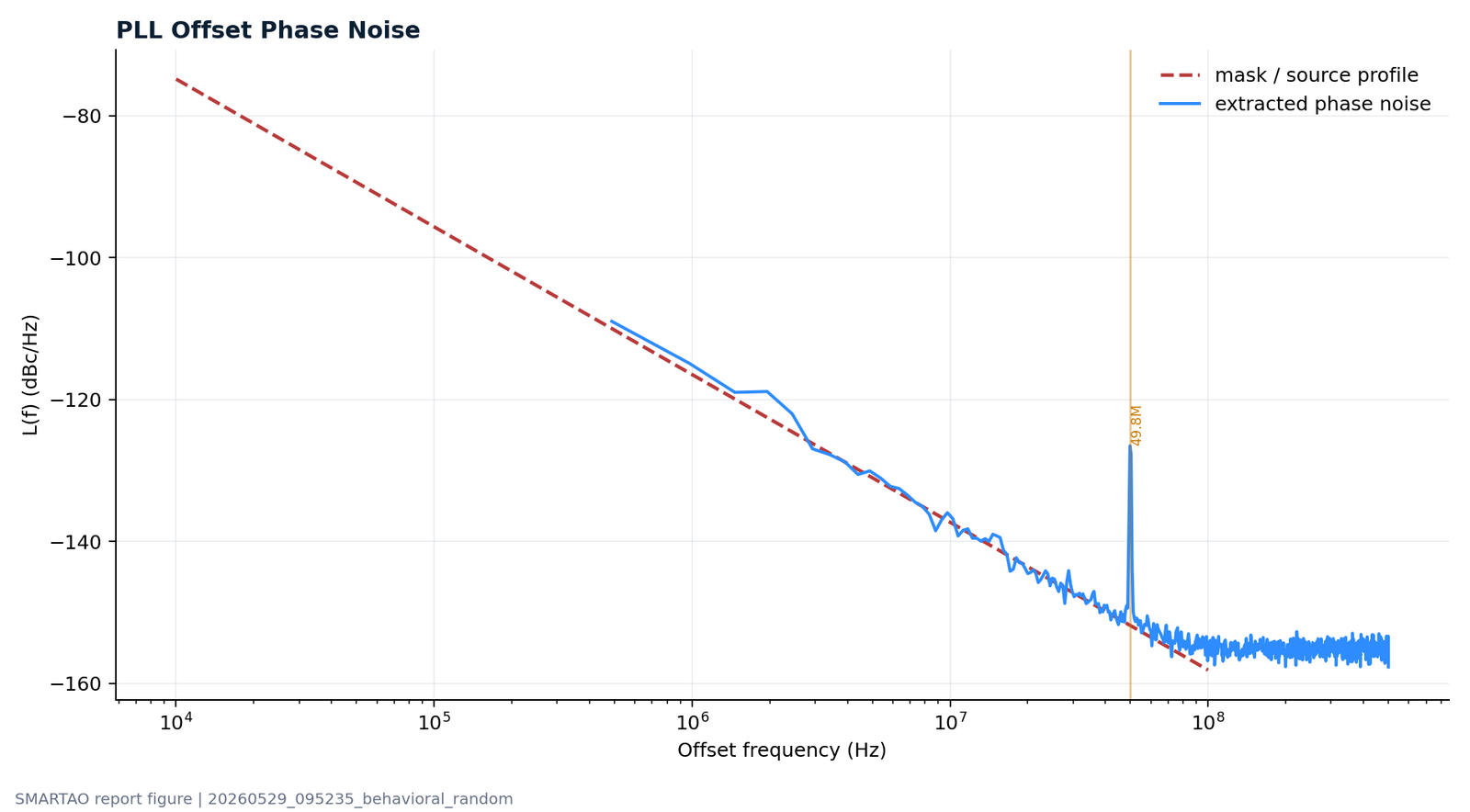
PLL long-transient phase noise

PLL long-transient phase noise

PSD, offset phase-noise mask, jitter, reference spur, and fractional-spur extraction from waveform data.

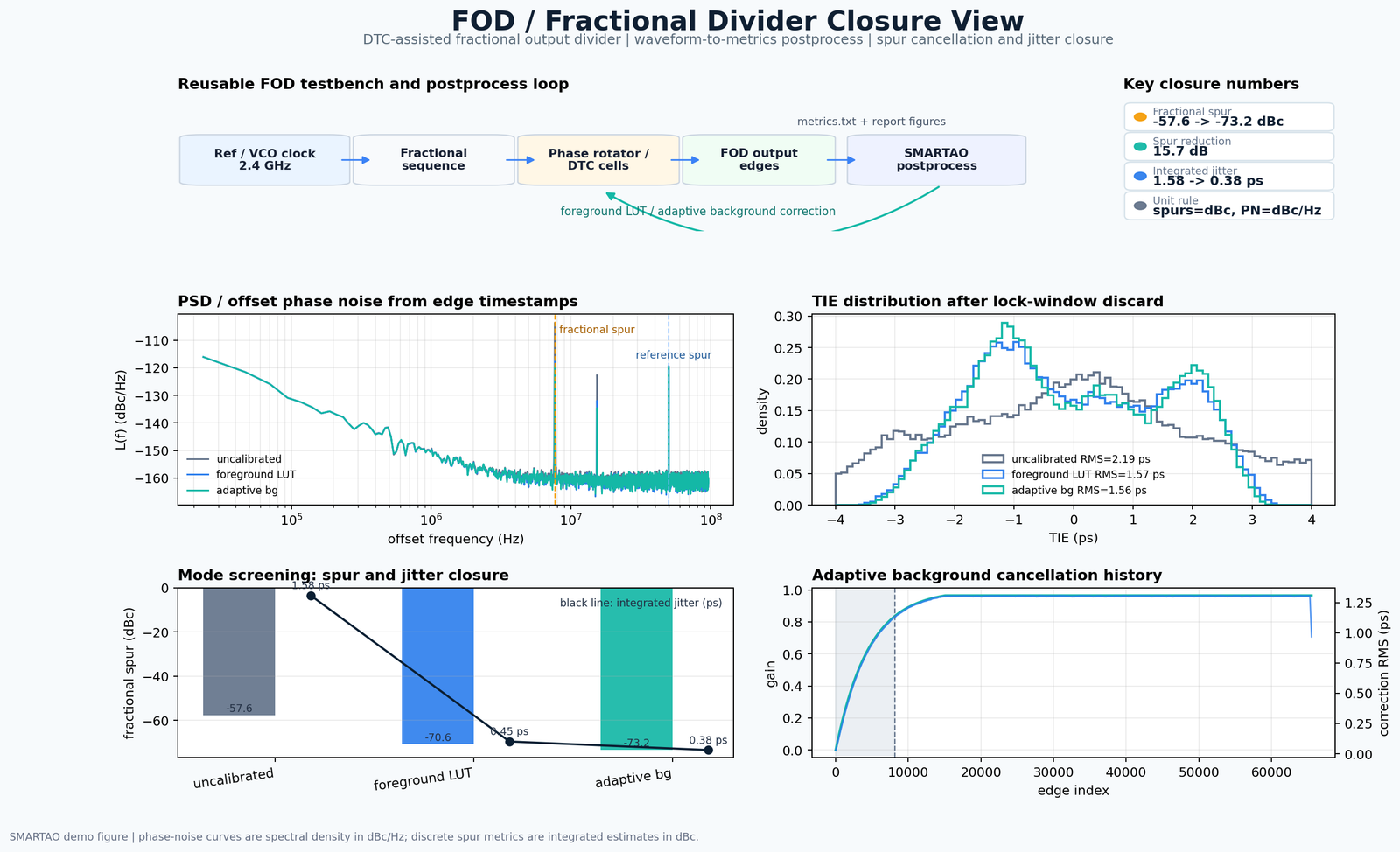
FOD fractional-divider closure

FOD fractional-divider closure

Shows the divider testbench loop, PSD/phase-noise extraction, TIE distribution, adaptive cancellation history, and residual spur reduction in dBc.

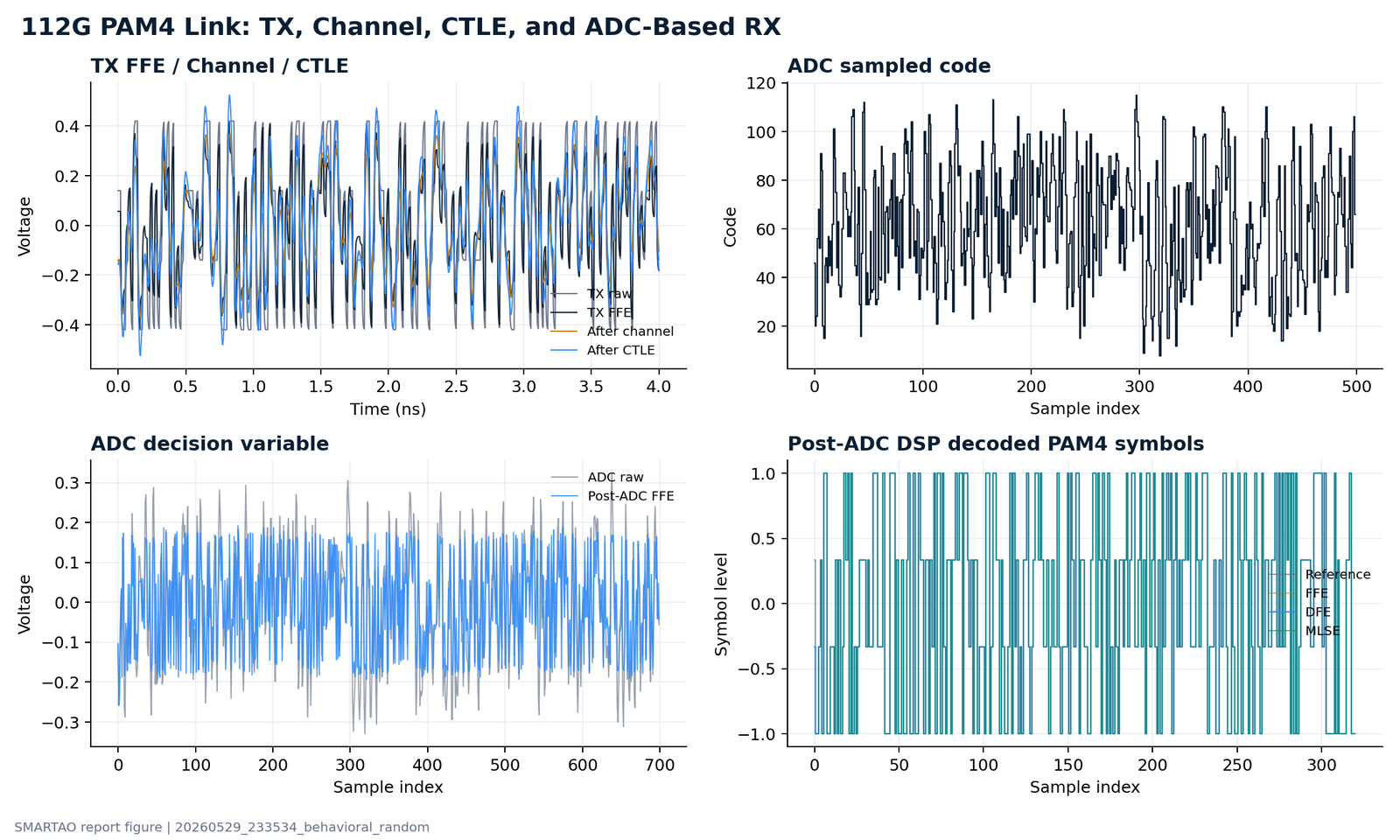
112G PAM4 ADC-based RX chain

112G PAM4 ADC-based RX chain

TX FFE, channel, CTLE, ADC samples, and post-ADC DSP decision variables in one view.

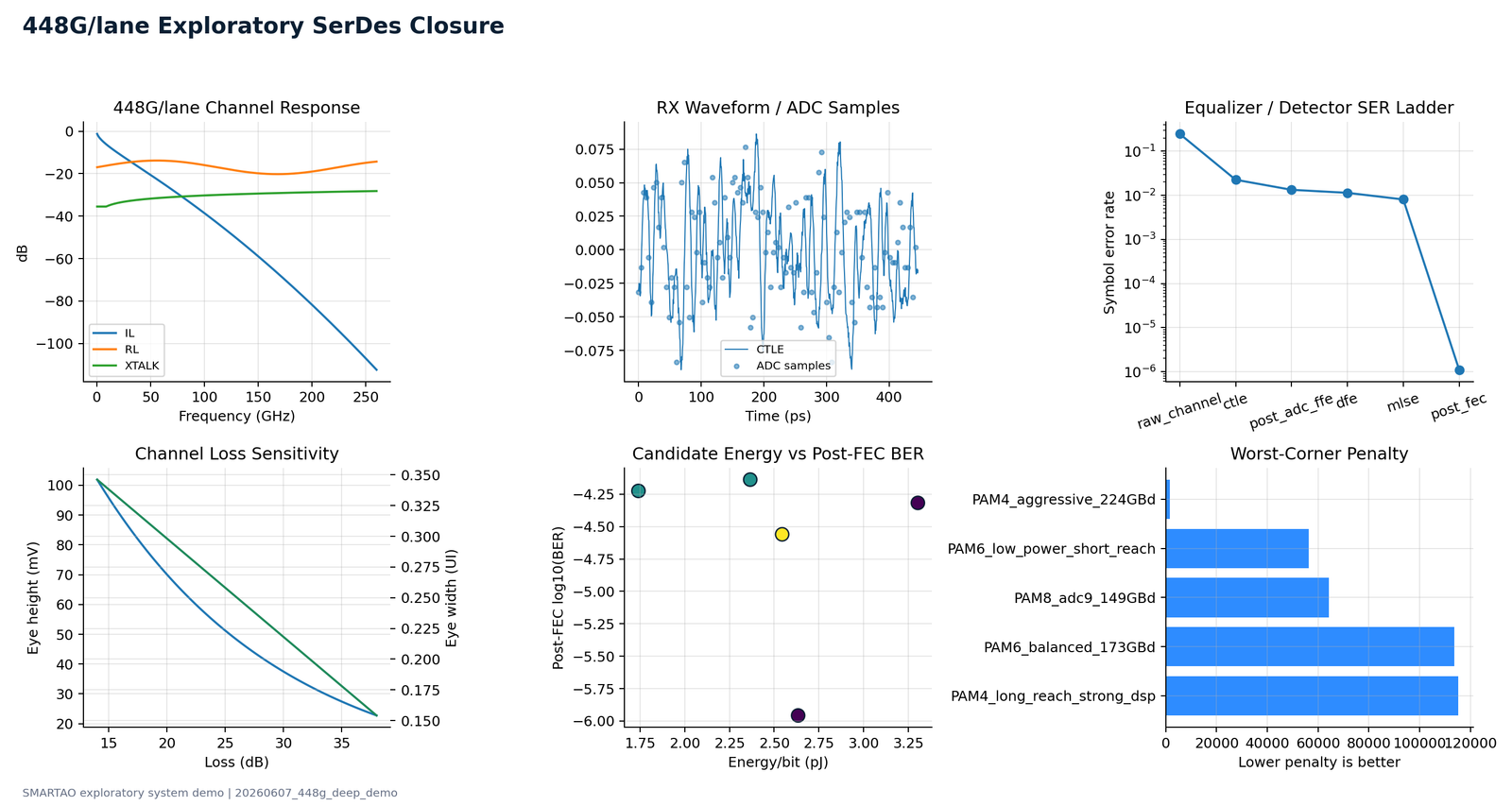
448G/lane exploratory SerDes

448G/lane exploratory SerDes

Forward-looking PAM4/PAM6/PAM8 architecture comparison with ADC-based RX, TX FFE, CTLE, FFE/DFE/MLSE, CDR, FEC waterfall, ADC-bit and channel-loss tradeoffs.

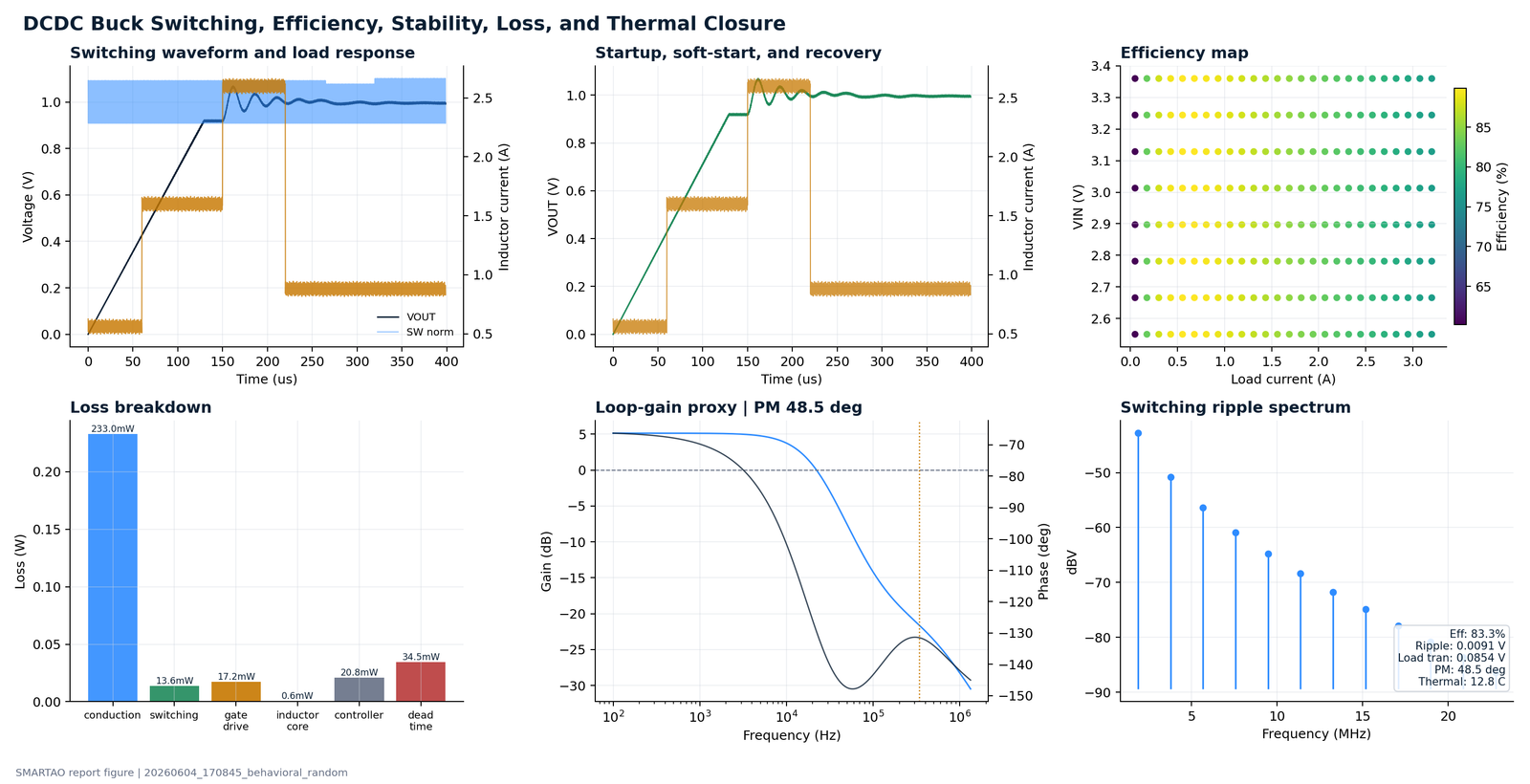
DCDC Buck deep closure

DCDC Buck deep closure

Switching waveform, startup, efficiency map, loop-gain proxy, ripple spectrum, loss breakdown, and thermal closure.

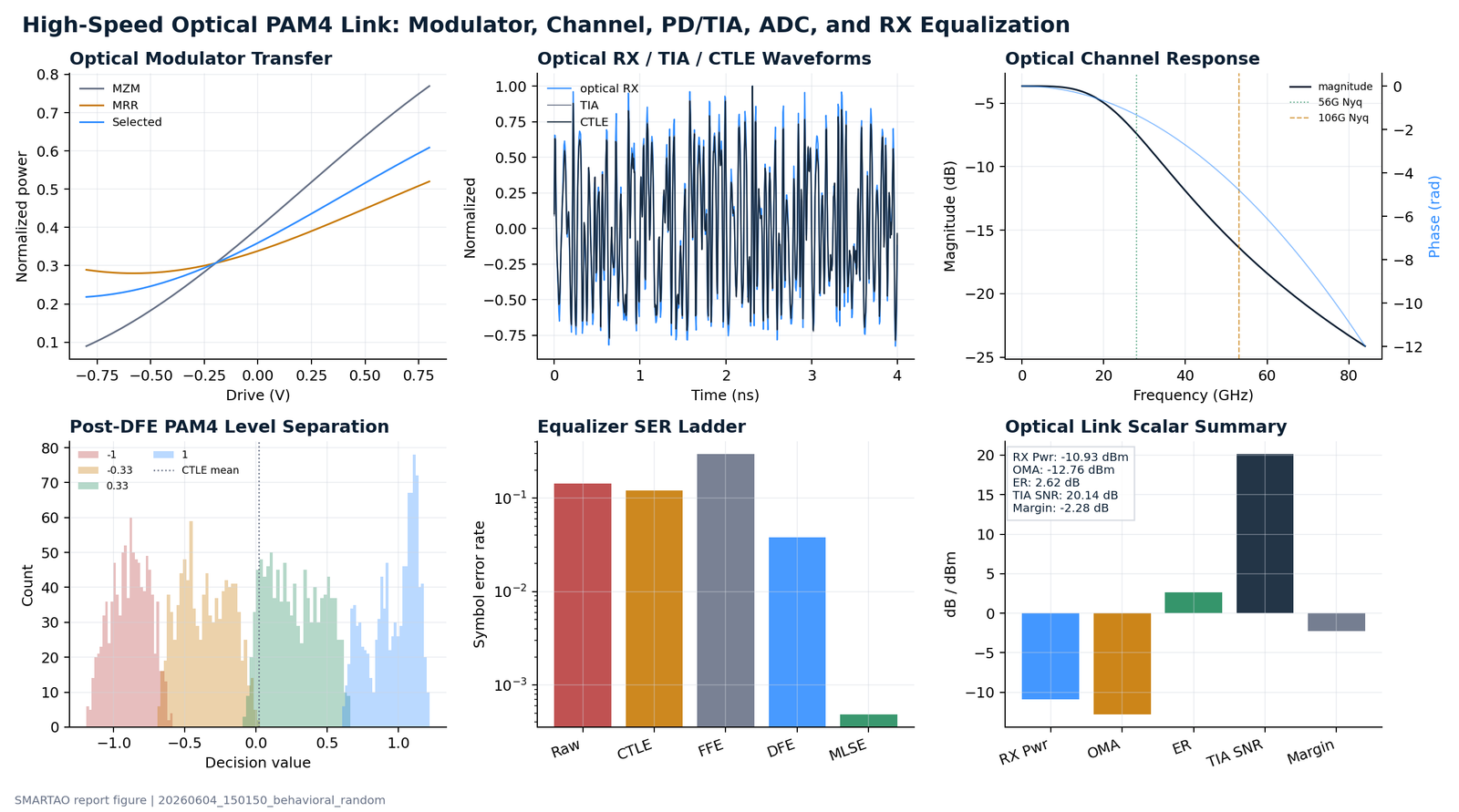
High-speed optical PAM4 link

High-speed optical PAM4 link

PAM4 stimulus, TX FFE, optical modulator/channel, PD/TIA, ADC, RX equalization, and link-quality metrics.

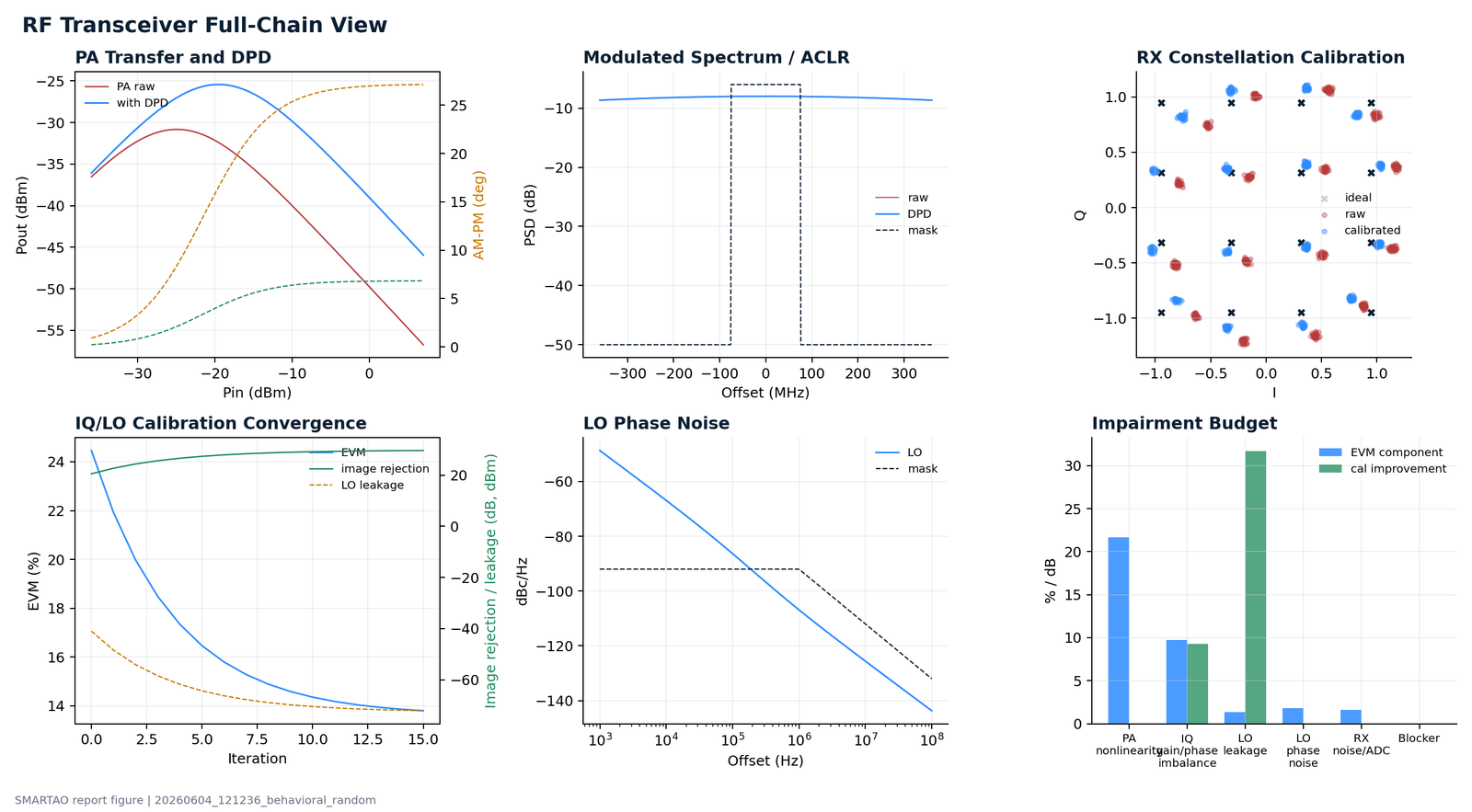
RF transceiver full-chain

RF transceiver full-chain

TX/RX impairment budget with DPD, PA nonlinearity, IQ imbalance, LO leakage, phase noise, EVM, ACLR, and calibration closure.

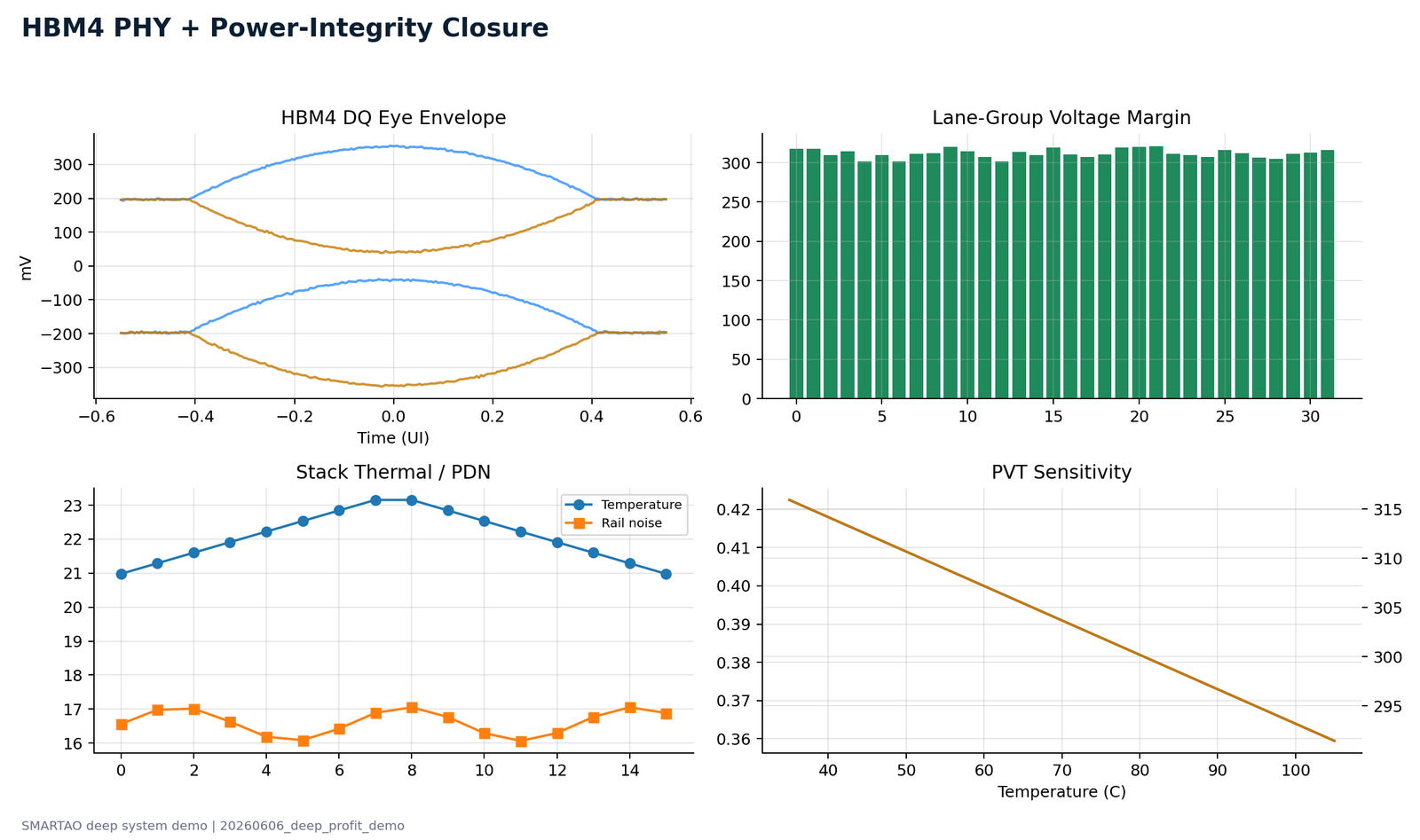
HBM4 PHY + power-integrity closure

HBM4 PHY + power-integrity closure

HBM4-style DQ eye, lane-group margins, WCK/DQ training, stack thermal/PDN behavior, PVT sensitivity, bandwidth, and energy closure.

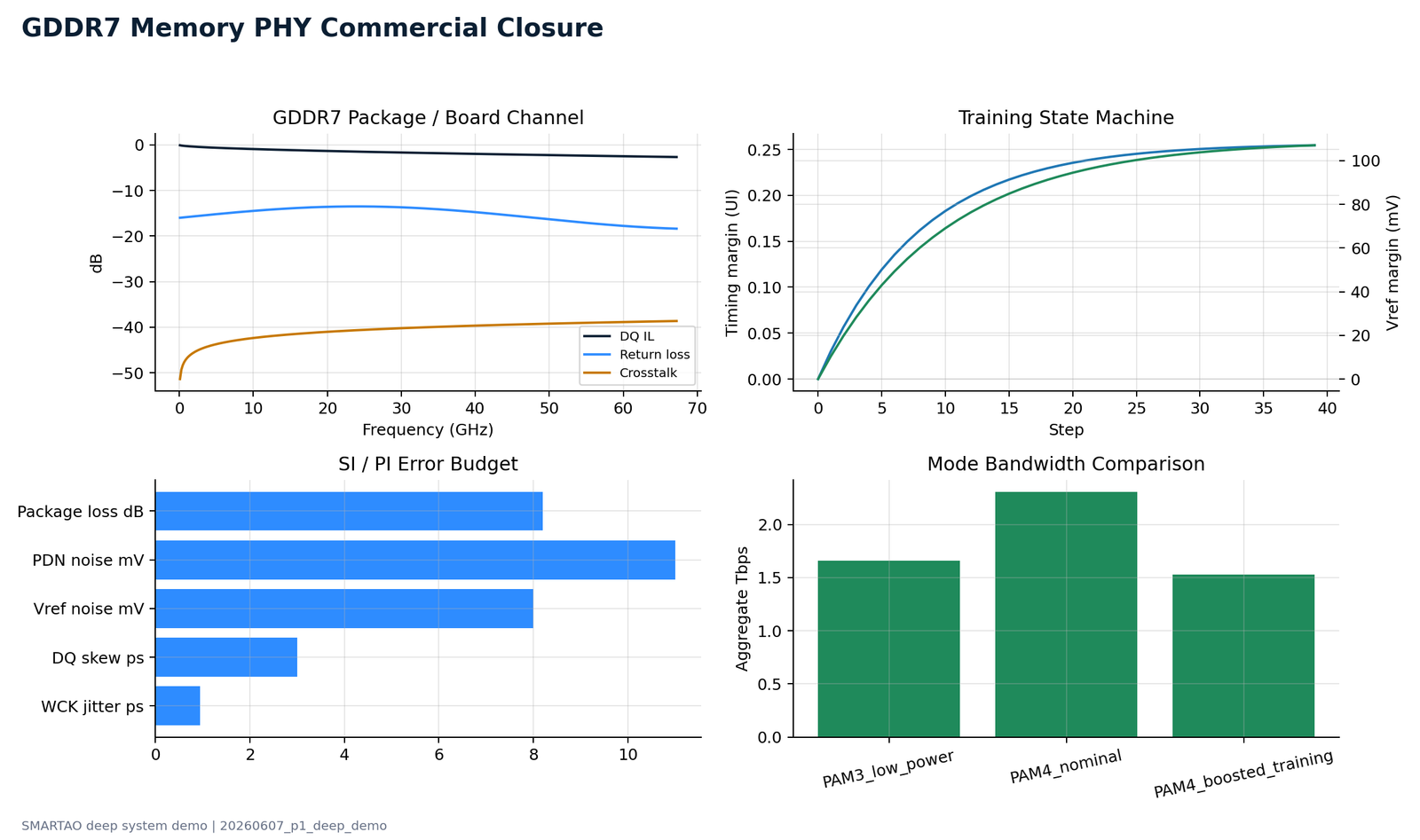
GDDR7 memory PHY closure

GDDR7 memory PHY closure

Discrete high-speed memory PHY view with channel response, lane margin, clock/data training, SI/PI stress, bandwidth, and energy closure.

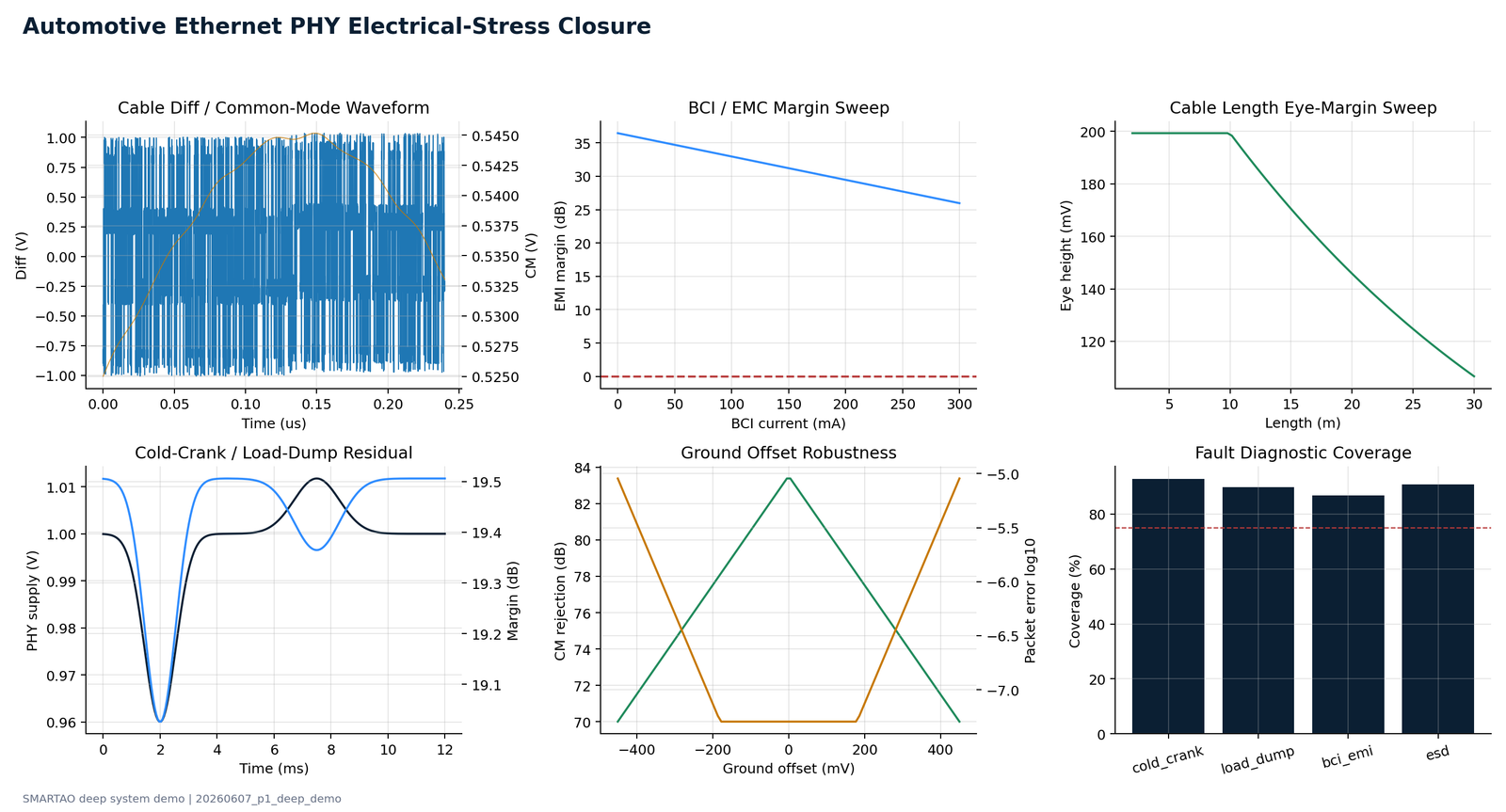
Automotive Ethernet PHY electrical-stress/link closure

Automotive Ethernet PHY electrical-stress/link closure

Vehicle cable waveform, BCI/EMC margin sweep, cable-length eye margin, cold-crank/load-dump supply stress, ground-offset robustness, ESD recovery, and diagnostic closure.

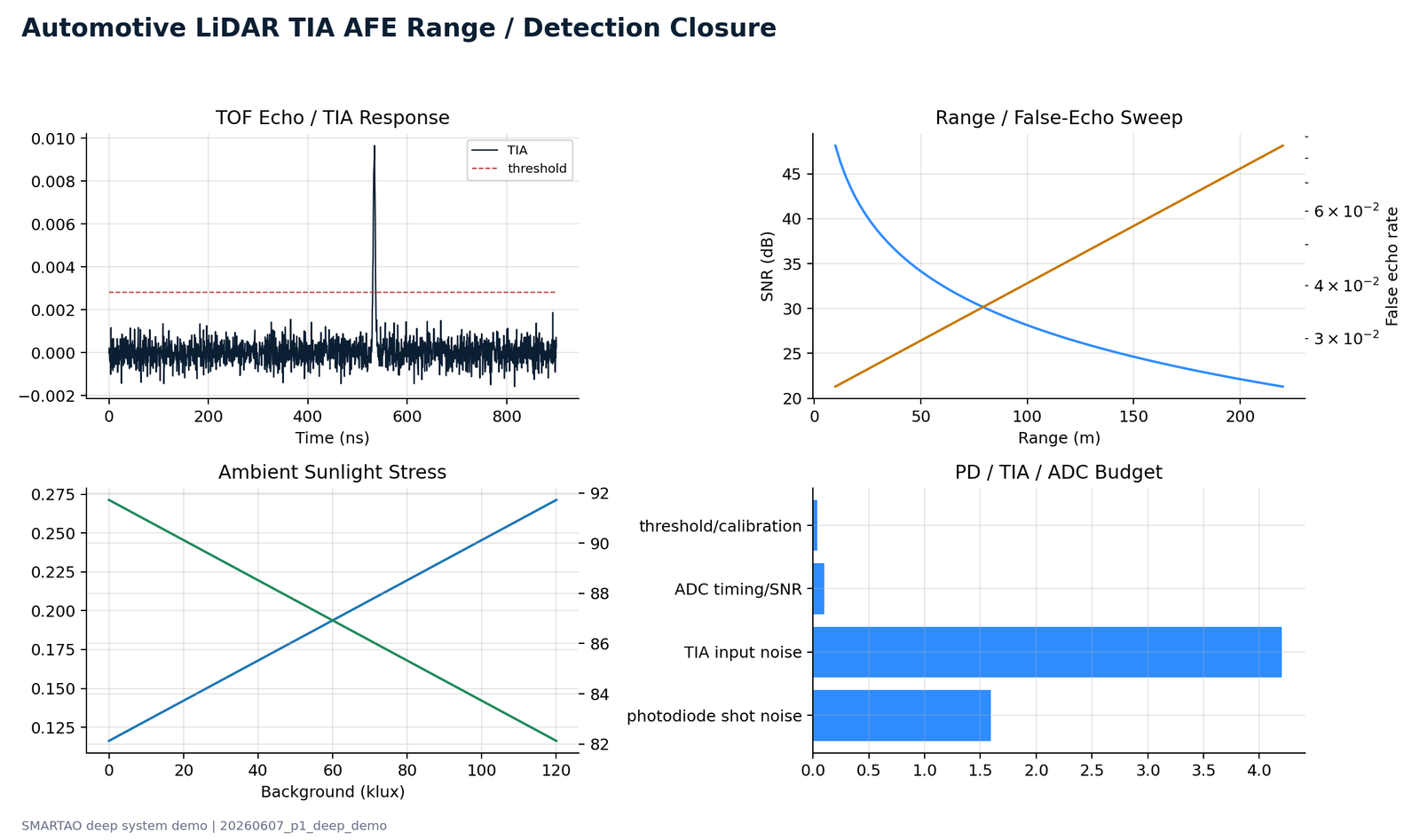
Automotive LiDAR TIA AFE closure

Automotive LiDAR TIA AFE closure

TOF echo waveform, TIA thresholding, range/SNR/false-echo sweep, ambient sunlight stress, and PD/TIA/ADC error budget.

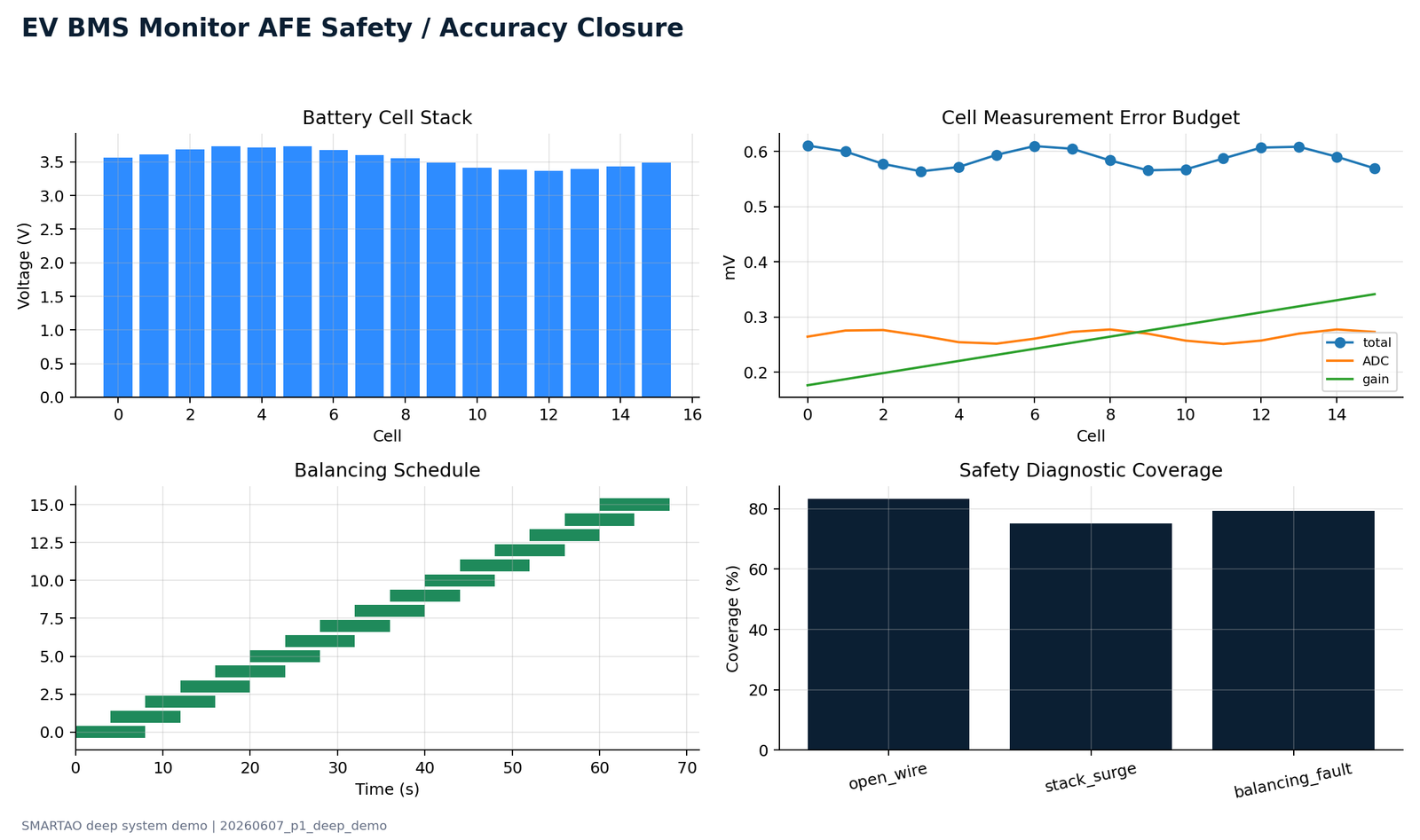
EV BMS monitor AFE safety closure

EV BMS monitor AFE safety closure

Battery stack measurement, cell error budget, balancing schedule, open-wire/surge diagnostic matrix, and low-quiescent safety closure.

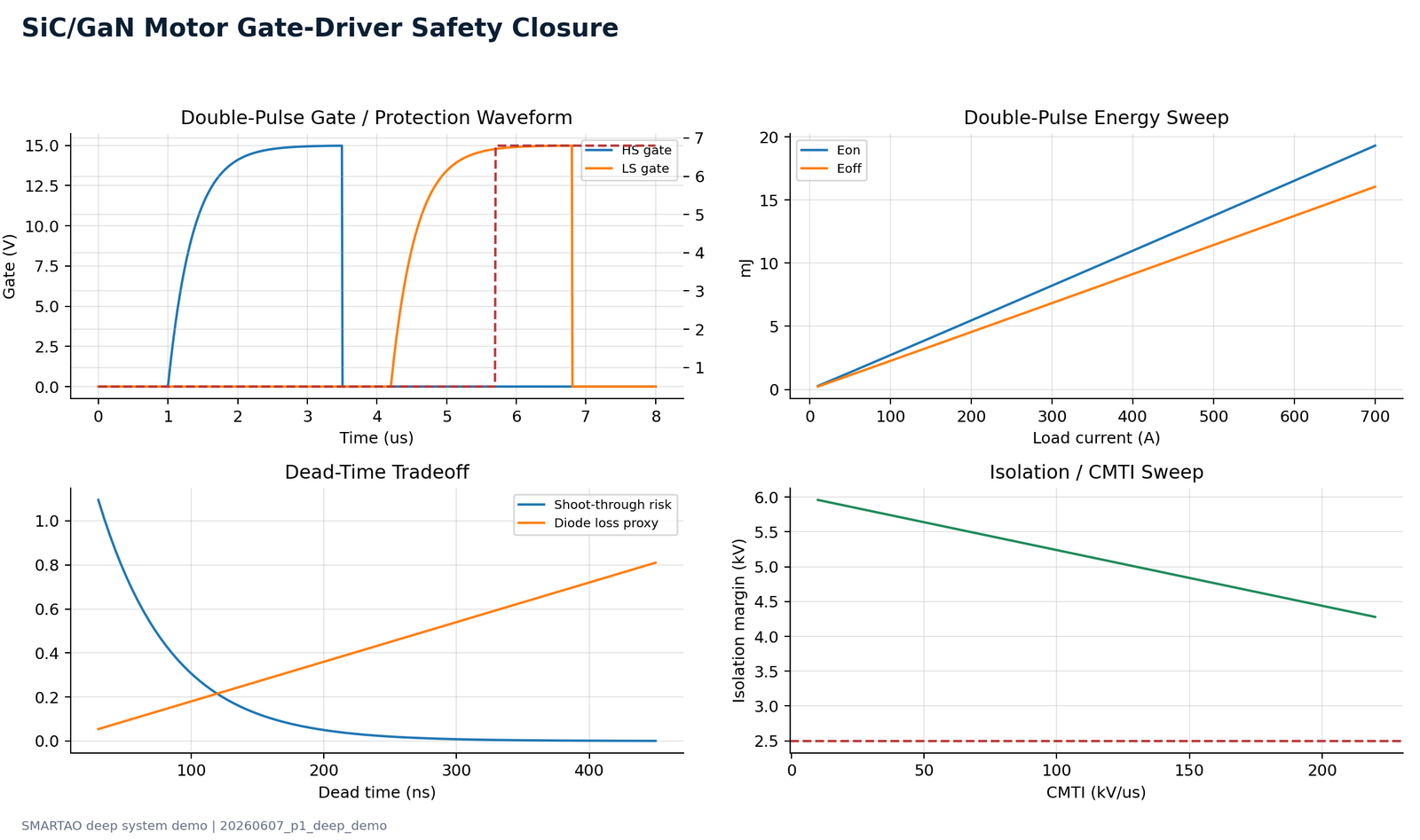
SiC/GaN motor gate-driver safety closure

SiC/GaN motor gate-driver safety closure

Double-pulse gate waveform, DESAT/UVLO protection, switching-energy sweep, dead-time tradeoff, isolation/CMTI margin, and safety diagnostics.

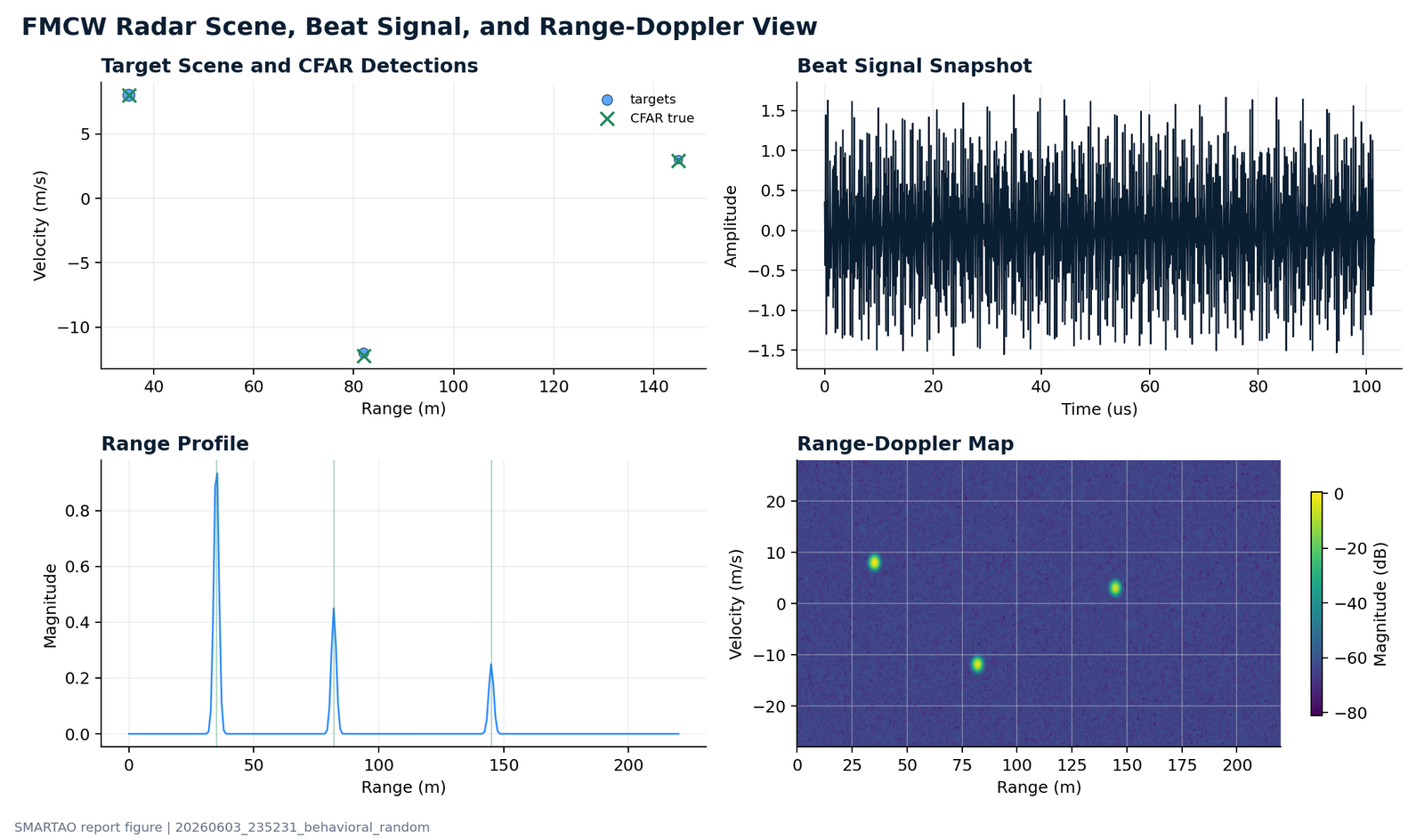
FMCW radar range-Doppler

FMCW radar range-Doppler

Chirp scene generation, beat waveform, range profile, range-Doppler map, detection view, and radar metric closure.

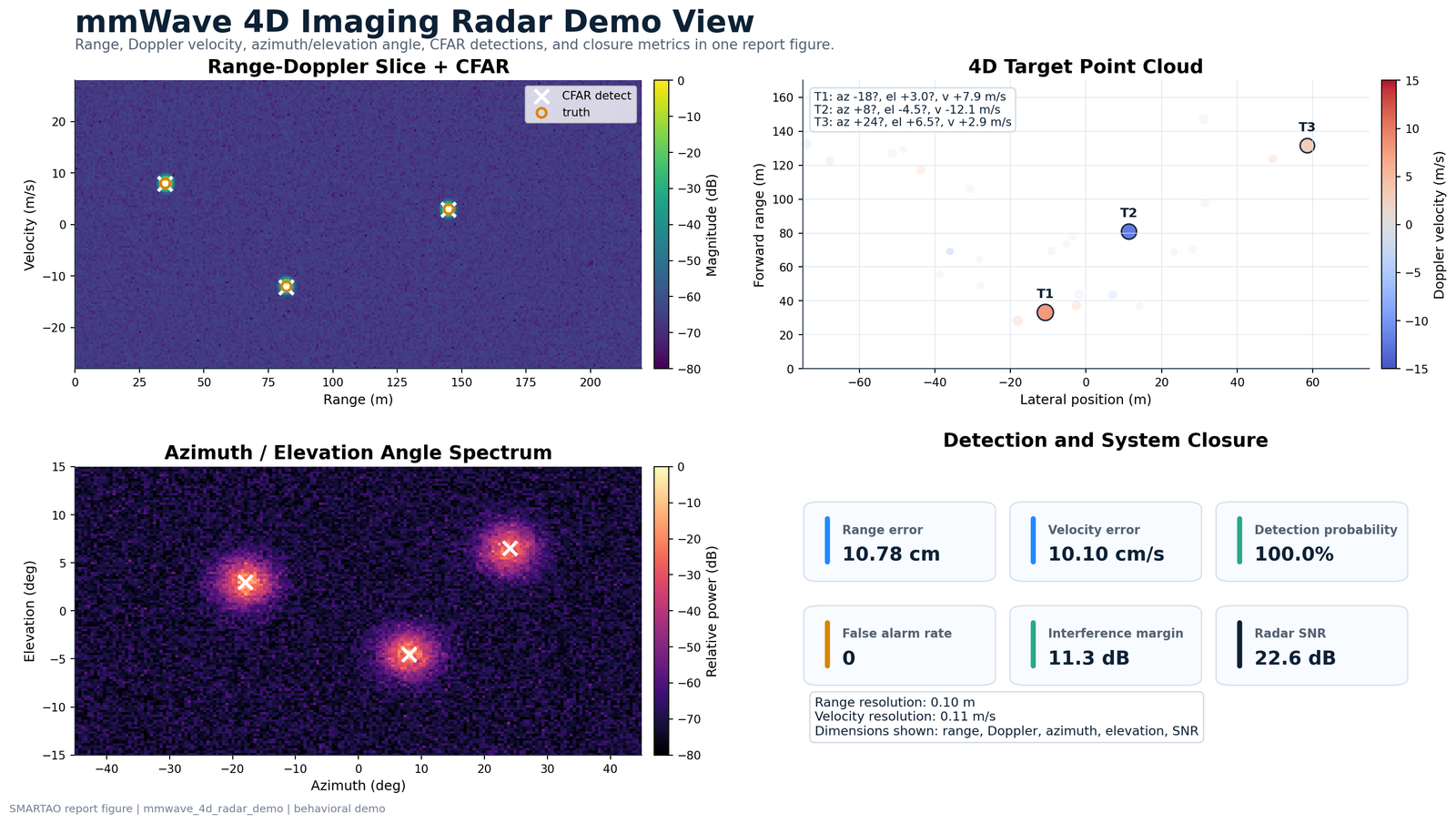
mmWave 4D imaging radar

mmWave 4D imaging radar

Range-Doppler map, CFAR detections, azimuth/elevation spectrum, target point cloud, and system closure metrics.

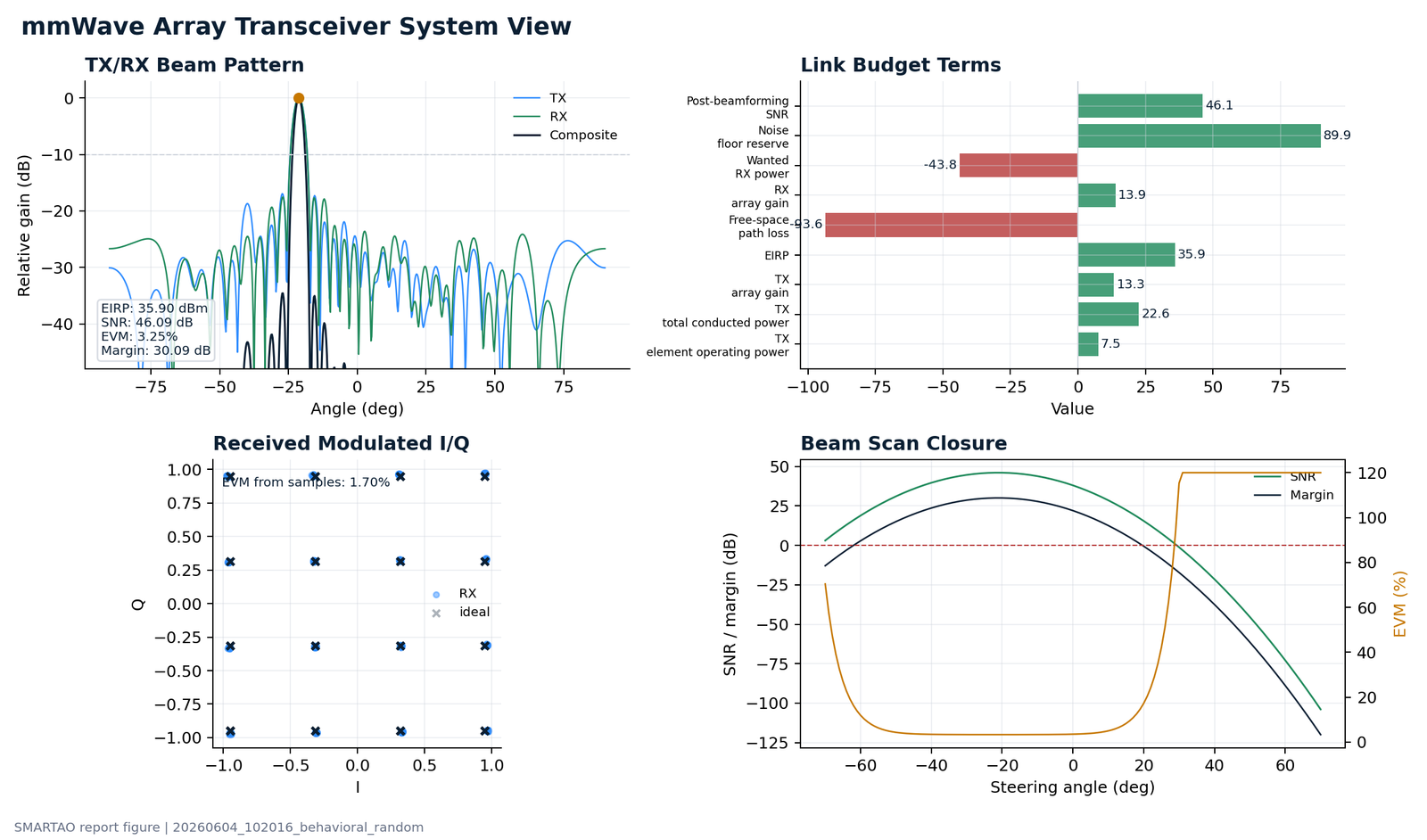
mmWave array transceiver

mmWave array transceiver

Beamforming, TX/RX link budget, blocker behavior, scan metrics, EVM, sidelobe, and array-calibration style closure.

NTN / SATCOM direct-to-device link

NTN / SATCOM direct-to-device link

LEO Doppler tracking, NTN/D2D constellation, service pass margin, spectrum-mask closure, handover stress, and broadband SATCOM mode coverage.

1.6T / CPO optical interconnect closure

1.6T / CPO optical interconnect closure

Lane aggregation, optical modulator/channel, PD/TIA behavior, RX equalization, OMA, extinction ratio, SNR, FEC margin, and energy-per-bit closure.

Datacenter >1000A PDN closure

Datacenter >1000A PDN closure

Rack bus, board VRM, package/on-die PDN, target impedance, AI workload load steps, phase current sharing, connector aging, phase-fault ride-through, and thermal closure.

MIPI camera sensor interface

MIPI camera sensor interface

Lane waveform, timing/voltage margin, lane skew, common-mode behavior, frame-error proxy, and settling-time closure.

WiFi7 / 5G RF FEM system closure

WiFi7 / 5G RF FEM system closure

OFDMA/RU allocation, spectrum mask, MIMO beam/null behavior, EVM budget, rate adaptation, high-order QAM, and RF FEM closure.

Bluetooth 6 channel sounding closure

Bluetooth 6 channel sounding closure

PBR phase-slope extraction, RTT fusion, 2.4GHz coexistence channel map, DBAF/advertiser monitoring, ISO latency, and architecture tradeoff closure.

PCIe 7 / CXL / UCIe interconnect closure

PCIe 7 / CXL / UCIe interconnect closure

PCIe/CXL/UCIe mode comparison, interposer/package channel, lane timing and voltage margin, clock/data training, SI/PI sensitivity, bandwidth, BER, and energy-per-bit closure.

224G segmented CTLE equalization

224G segmented CTLE equalization

Low/mid/high-frequency equalization branches, segment controls, waveform contribution, and receiver margin exploration.

Use Cases

Where AnalogPilot is most valuable first.

The strongest early use cases are IP blocks and system scenarios where the engineering loop is expensive, testbenches are reusable, and scalar specs do not tell the whole story.

01

Power IP

LDOs, digital LDOs, DC-DC converters, battery paths, UVLO/POR, power integrity, automotive PMIC scenarios, and datacenter high-current PDN closure.

02

Clocking and PLL

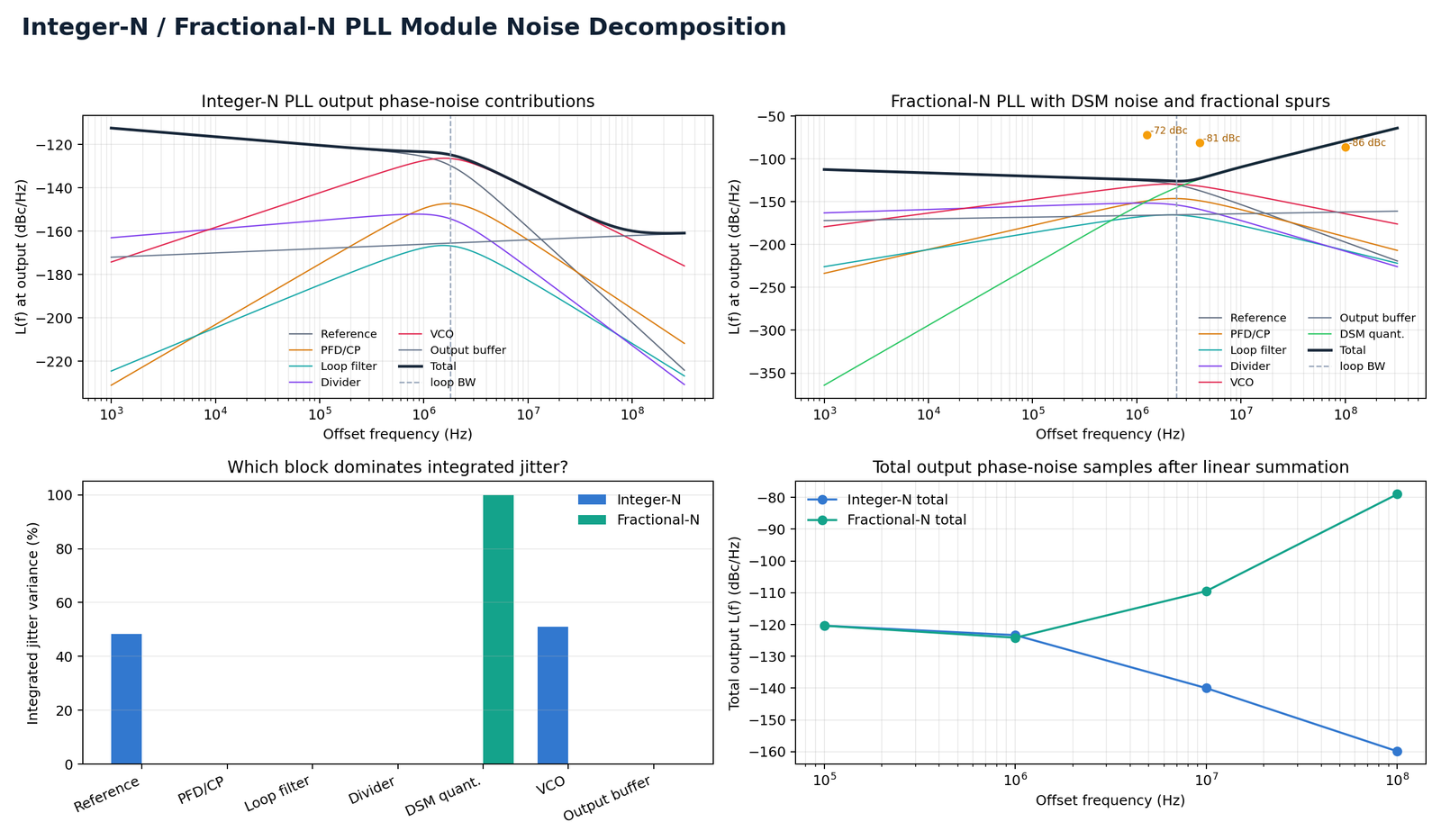
Integer/fractional PLLs, ADPLL/DCO, VCOs, FOD/phase-rotating dividers, DTC/TDC, LO distribution, jitter injection, phase-noise and spur workflows.

03

High-Speed IO

112G/224G/448G exploratory SerDes, ADC-based receivers, TX FFE, CTLE, FFE/DFE/CDR, MLSE/Viterbi post-processing, FEC waterfall views, and PAM4/PAM6/PAM8 stimulus generation.

04

RF/mmWave

LNA, PA, mixers, RF switches, phase shifters, front-end modules, mmWave phased arrays, radar, WiFi/cellular, and SATCOM-oriented tests.

05

Data Conversion

SAR, sigma-delta, time-interleaved, pipelined, hybrid ADCs, DACs, sample-and-hold, code-density and FFT post-processing.

06

Passive / EM

Inductors, transformers, baluns, transmission lines, couplers, filters, RLCK fitting, layout SKILL seeds, and EM-to-circuit closure.

Workflow

A practical path from one reusable flow to a scalable platform.

AnalogPilot can start from an existing circuit block, system scenario, or internal demo and expand it into reusable simulation, system verification, optimization, modeling, and reporting infrastructure.

01

01

Define block/system goals, specs, corners, candidate architectures, and reusable variables.

02

02

Bind Cadence testbenches, node maps, stimuli, metrics, postprocess profiles, and report views.

03

03

Run optimization, PVT/MC validation, model calibration, visual reporting, and candidate comparison.

04

04

Reuse the verified flow across new design instances, architectures, PDK implementations, or related systems.

Deployment boundary

Project design data, PDK paths, simulation outputs, and local project knowledge can remain inside the deployment workspace. Platform files and project-specific instances are kept structurally separate.

SMARTAO

SMART = intelligence, efficiency, automation. TAO = method, engineering path, tools, and discipline. The brand stands for practical automation that guides complex semiconductor design toward verifiable and reusable results.

Insights

Technical articles to build market awareness.

These short technical notes explain the engineering principles behind reusable RF/analog automation: testbench infrastructure, high-speed link optimization, and AI-assisted workflows that respect design confidentiality.

Why analog IP optimization needs reusable testbench infrastructure

Analog optimization is usually limited by how repeatable the measurement loop is, not by the optimizer itself.

Analog IP optimization is not limited by the optimizer. It is usually limited by how repeatable the measurement loop is.

For many analog and RF blocks, the real engineering effort sits in the testbench: biasing the DUT correctly, applying realistic stimuli, defining corners, extracting meaningful metrics, and making sure every candidate is evaluated in the same way. Without reusable testbench infrastructure, every optimization run becomes a fragile one-off experiment.

A good reusable testbench standardizes the interface between design variables, simulation setup, and measured results. The optimizer should not need to understand every schematic detail. It should see a clean parameter set and a consistent metrics file.

It also captures engineering judgment. The right load transient for an LDO, the right two-tone setup for an LNA, the right jitter and channel condition for a SerDes receiver, or the right FFT window for an ADC are all part of the design knowledge. Reusable testbenches preserve that knowledge.

Most importantly, reusable testbenches make results comparable. Architecture A, architecture B, different PDK corners, and later design revisions can all be evaluated through the same measurement contract. That is what turns optimization from trying many simulations into a disciplined design flow.

What 112G SerDes optimization needs beyond a single eye diagram

A single eye diagram can show whether one case looks open, but it cannot explain where the link margin came from.

An eye diagram is useful, but for 112G SerDes it is not enough.

At 112G PAM4, the link is a chain of tightly coupled impairments: TX FFE tap settings, package and channel loss, CTLE peaking, ADC resolution, clock jitter, CDR behavior, FFE/DFE adaptation, and sometimes MLSE or other sequence detection. A clean-looking eye at one point in the chain may not tell you why the link works, where the margin comes from, or what will fail across corners.

A stronger optimization flow needs stage-aware metrics. Before the receiver, we need channel insertion loss, return loss, crosstalk, and TX pre-emphasis. Inside the receiver, we need CTLE response, ADC input range, quantization noise, timing margin, and equalizer convergence. After detection, we need SER or BER estimates, error distribution, jitter tolerance, and adaptation stability.

It also needs realistic stimuli. PAM4 symbols, PRBS patterns, jitter injection, bandwidth-limited channels, and stressed channel conditions reveal problems that a simple waveform snapshot can hide.

A single eye diagram answers, does this case look open? A serious 112G SerDes optimization flow answers why it is open, how much margin exists, and which knobs actually created that margin.

How RF/analog teams can use AI without giving away design IP

AI can assist the workflow while schematics, PDK data, layouts, and proprietary waveforms remain inside the company environment.

RF and analog teams can benefit from AI without exposing schematics, PDK data, or proprietary design details.

The key is to keep AI close to the workflow, but far from confidential implementation data. Instead of sending full schematics or layouts to an external model, teams can expose structured, limited information: block type, target specs, allowed variables, simulation status, metric names, and anonymized failure modes.

AI is especially useful around the design loop. It can help generate test plans, suggest likely measurements, organize optimization variables, explain failed simulations, compare candidate results, and draft reports. These tasks need engineering context, but not the full circuit.

A safe architecture separates three layers: a private layer for schematics, PDK files, simulation waveforms, extracted views, and customer-specific IP; a structured interface layer for sanitized specs, corners, variable ranges, metric outputs, logs, and workflow states; and an automation layer that applies approved actions locally.

For RF/analog design, the most practical use of AI may not be generating a complete circuit. It may be helping engineers run better experiments, reuse knowledge, diagnose issues faster, and turn simulation data into decisions while keeping the real IP safely inside the design environment.


Contact

Build RF/analog IP and systems faster, with more reusable engineering evidence.

AnalogPilot is suitable for internal IP development, Cadence-centered circuit/system automation, reusable modeling infrastructure, and technical discussions around RF/analog IC and system-level automation.

SMARTAO AnalogPilot

A SMARTAO product

Founder: Yusheng (Boris) Chen

RF/Analog IC automation and mixed-signal systems

info@smartao.ai

+1 669 294 3892

WeChat: Smartaoai

analogpilot.smartao.ai

SMARTAO company site

AI-powered · Engineer-driven · RF/Analog Innovation